
My faith community is currently studying the book of Psalms. When we began last October, a box of envelopes was passed around containing verses from the Psalms. We were to pick one to accompany us through the course. For my homily in February, I decided to focus on the verse I chose. Only one verse — how hard could it be?
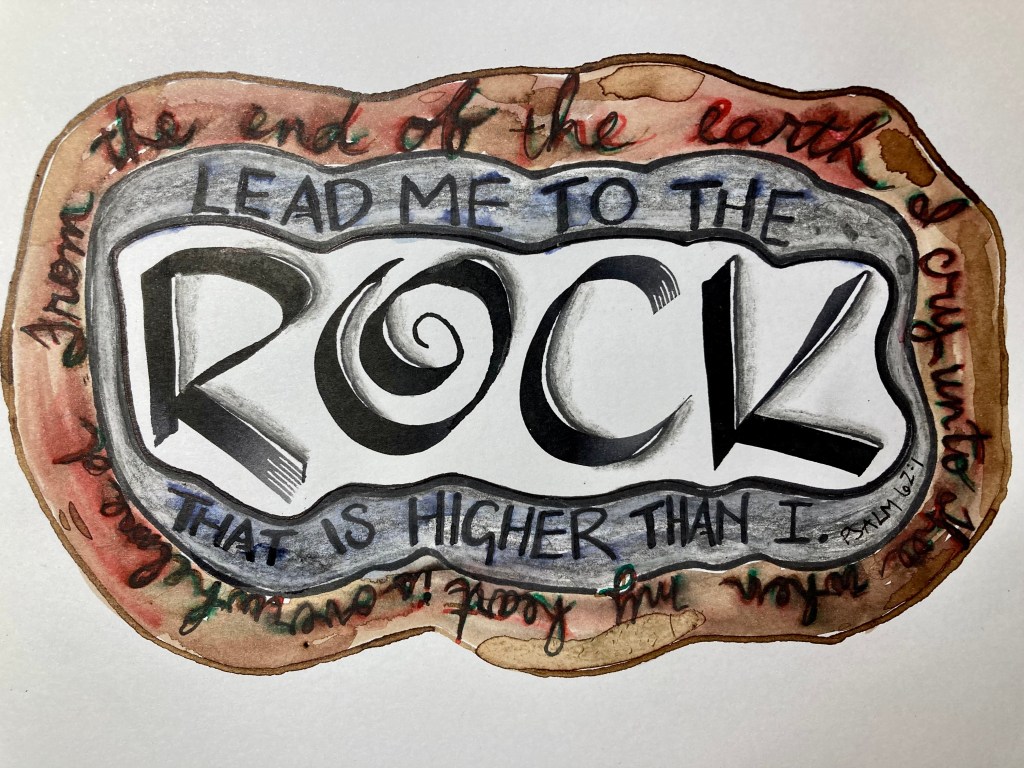
To be honest, I didn’t really like it. It seemed…kind of obvious, like telling someone they should exercise, or drink more water. Of COURSE I’ll let God lead me to that higher rock than I when I’m in trouble. Duh. Isn’t that my life’s intention? What’s not to like? It’s a verse that, for me, felt so familiar I didn’t hear it anymore.
Still, I knew it was time for a second look and allow it to be the prayer I saw my life through. I journaled about it, lettered it in calligraphy, pondered significant rocks in my life, and reflected on the “higher places” God has provided for me. I journaled some more.
After this “creative right brain” prep, it was time to turn to the commentaries and that was when I hit a speed bump. Psalm 61 is not in the Lectionary, and so nothing turned up in the online resources I usually use. A friend lent me two commentaries but they amounted to less than 2 pages on this verse.
This might not seem like a big deal, but it began a time of unraveling for me, becoming frantic and bit depressed. I’d wanted something substantial to say but instead, all I was left with were my own dusty thoughts in the wilderness. The verse was short, just 25 words, and any thoughts of hope or consolation were much shorter. Cue the crickets.
This was mid January and I had still been feeling the afterglow of my cohort, but now its consolation evaporated like the morning fog. I’d needed those myriad resources to guide me and give me something half intelligent to say, but all I had was this ROCK that I was supposed to be led to. It seemed highly inefficient, and like a rock, highly uncomfortable. What was God thinking?
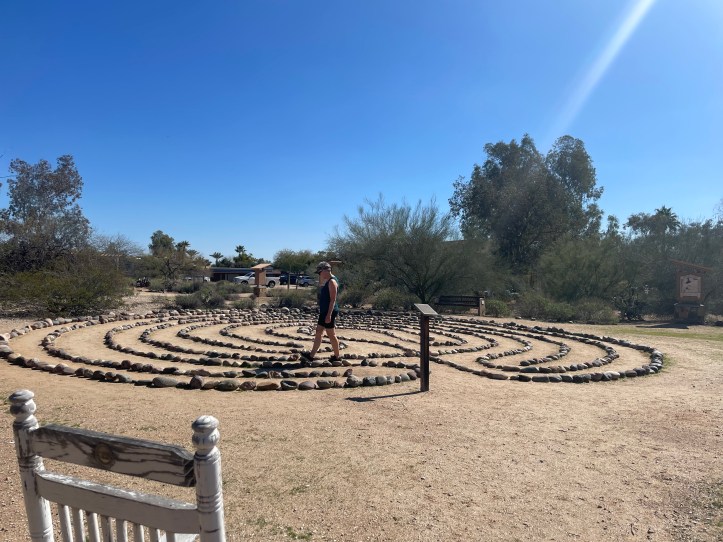
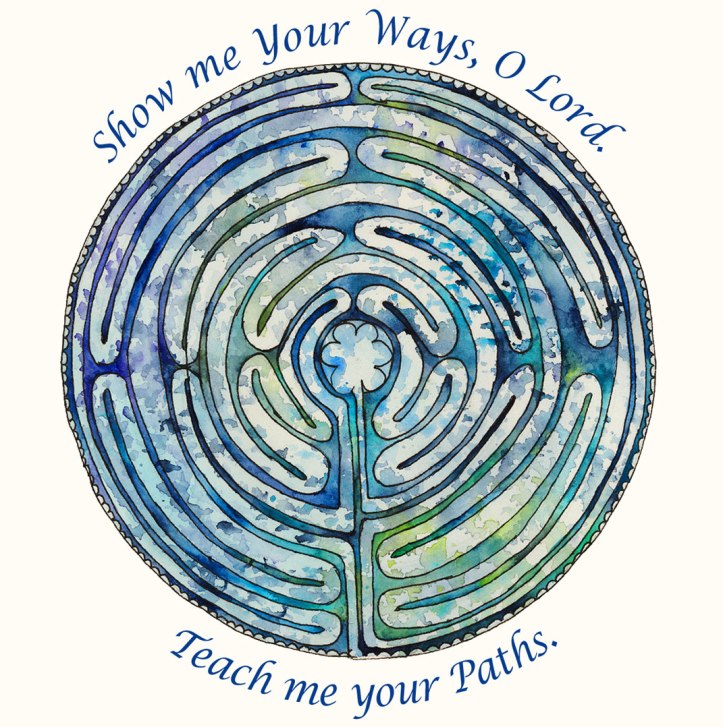
Psalm 61 is the prayer of an exile who laments his displacement. When he cries to God “from the ends of the earth”, he is at the very farthest point possible from the Temple, his spiritual home. It’s like he’s sinking and is asking God to put him in a place of safety; on a rock that is higher than his circumstances. I thought back to the labyrinth we’d walked in Dallas. Joe had taught that whether near or far, we’re never NOT on the path towards the center, where the beloved Holy is who calls us holy as well. Despite feeling “at the end of the earth”, surely I was still on the journey, on the labyrinth’s outer edges. Have patience, I told myself.
That’s when insomnia began setting in, which made my predicament much worse. Never mind the lack of resources, how was I supposed to prepare with a foggy brain? I felt completely disconnected from God, with a flat affect, off the grid and kicked off the labyrinth. One night I cynically lamented to God that the sprouts of new life from the cohort now seemed like a cruel joke. This mythical rock didn’t just seem remote and distant, it felt non-existent.
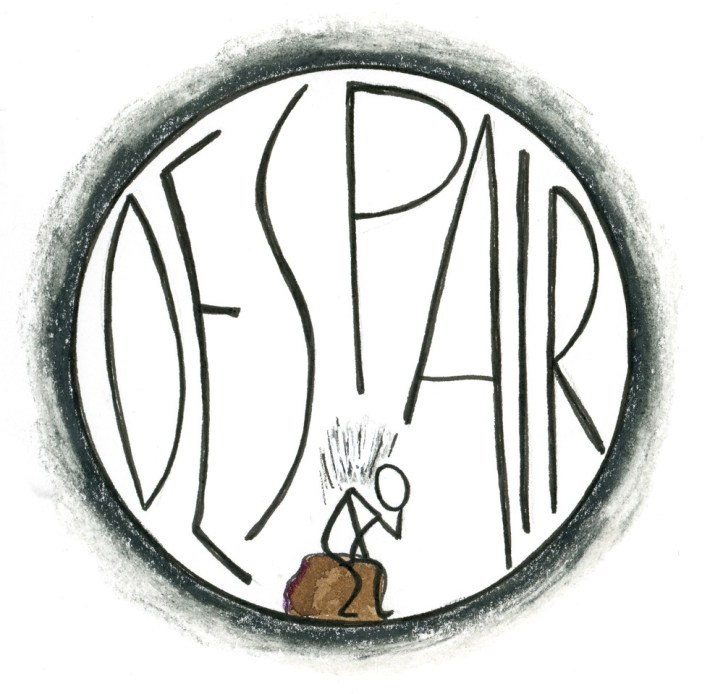
I hesitated to share this in my homily. Surely my suffering pales in comparison to the suffering in our world today. My infrastructure is still sound, who am I to lament with the psalmist who probably had it way worse? Was God just hearing the whining of a privileged pilgrim? My white guilt only added to my sense of lostness. From the end of the earth indeed, with no idea which way home was.
I realized I’d been reading the verse with a bias. The way I usually operate is, “When my heart is overwhelmed, I’ll head on over to the rock that is higher than I.” I’ll read a book, listen to a podcast, exercise… but all this implies agency and control on my part. I had none. I had no idea how to get to that rock. Like the exiled pilgrim, I felt far away. I was crying out but nothing helped. I couldn’t see God my rock in sight.
In C.S. Lewis’ classic parable, The Great Divorce, the experience of hell is a grey city. The inhabitants live an increasingly joyless and friendless life as they move further and further away from their neighbors. They can escape this grey hell anytime though. Every day a bus is ready to take them to a better place, but there’s a catch. They have to let go of their own security and accept their reliance on the guides God provides (which is both a painful and healing process in the dream that forms the book). You’d think this is a small price to pay to get out of hell but most sullenly either remain or return to this increasingly private hell which they choose instead of heaven.
This described where I felt I was. I knew there was a bus out but I felt stuck on one of the bends on the labyrinth’s winding path. I know everyone is familiar with being stuck. Not just in our outer circumstances, but the hell inside the hell where our mind and heart knows no peace.
Years ago during a study of the book of Revelation, I learned a helpful phrase, “I turned and I saw.” The writer, John, turns and sees…a voice of someone speaking, or a door, or golden lamp-stands. And somewhere in my plight, I turned and saw something that broke the spell. “I turned and saw” the psalmist’s lament during one of our study nights, though it took a while to sink in. “Please God, no more yelling, no more trips to the woodshed,” pleaded the Psalmist. “Treat me nice for a change…if you love me at all, get me out of here!” (Psalm 6 Message translation).
The lament woke me up to my predicament and helped me voice my despair to God. Lying awake (yet again) that night, I thought of Christina Robinson’s paraphrase of my verse, “I call on you from the end of my rope — hanging there with a heavy heart. HELP!” After hours of tossing on the couch, another verse from the our study’s lament came to me, “Get out of here, you Devil’s crew!” (6:8)
The psalms are rich in talking back to our enemies. Whoever we are, enemies always want to reduce us. The Message translation sure got it right, it was indeed a Devil’s crew stealing my life, trapping me in this hell of the grey city. I saw myself lying there with a frown and Psalm 6 gave me the nerve to talk back to the crew.
“Get the f**k out of here!!” I yelled. “Leave me alone! I want my life with God back.” (“Please God, no more yelling, no more trips to the woodshed. Treat me nice for a change!… 6:1-2).

I called my homily “From trouble to trust”, and I think it was this moment of utter desperation and anger that finally got me unstuck from my trouble. I turned and saw and God led me to the rock. Sleep came, and in the morning my flat affect turned to tears.
Throughout the cohort last year, Joe Stabile had told us that “surrender” was the essence of every religion, and of our year. That anger against my inner enemies was a cry of surrender, and behind it lay my prayer. “Break in, God, and break up this fight…if you love me at all, get me out of here. I’m no good to you dead, am I?” (6:4-5)
The lack of resources for my homily was the best commentary God could have provided. It led me into a desert which I now see was provisional. I realized that I’d been feeling sorrow at the loss of my cohort. The consolation of it was gone. I was no longer looking forward to another trip to the beloved Micah Center. The connections I’d experienced there, with the help of our wise teachers, were over. The temple seemed far away but what was worse was I didn’t feel something similar here. I’d wanted to be transformed, on top of things. Instead, I felt like the psalmist, like I was still at square 1, a kid lost at the park.
God gave me a place to live again, a place of refuge. I knew my laments were heard when Lyle came upstairs with a consoling hug and the assurance I’d get through this. When I wanted to buy earplugs at the pool later that day, all they had were children’s earplugs. “They’ll work for you,” the pool staff told me, and it seemed a good echo of my childish surrender. And inexplicably that day, my childhood 2nd mom, “Tante Bargen”, phoned just to tell me she was thinking of me and that she loved me. Once we’re on the rock, doesn’t everything seem to be a gift? I realized I was loved, not for some fancy words in a homily, not when I had it together, but in my unfixed state.
The rock higher than I is just a place of complete dependence. I didn’t know that, like the psalmist’s bed, it too could be soaked with tears. I’m glad God reminded me that crying out can include swearing at our enemies.
Can I trust that my journey isn’t over even if the cohort is? Can I trust that God is still healing me? Leading me to a higher place? Leading me to find the fulfillment I’d felt in Dallas even here? Maybe I didn’t need to DO anything to get there other than utter dependence and trust.
God has seen me through so many trials, inexplicably holding me together when I’ve cried out, keeping me alive in ways seen and unseen. Why wouldn’t it be true in 2024? As Rev. Jeremiah Wright, a black preacher, said, “You can’t keep down what God wants up. God never fails.”
 The Contemplative Blogger
Such a strong message, Lydia! I could feel your pain through your words. Wish we were meeting again for dinner before the Cohort began.
Your message around this Psalm verse reminded me of the book The Rock Which is Higher by Madeleine L’Engle. She is one of my beloved lifelong authors. If you read it, please let me know.
More to come in an email as I continue to read & appreciate your Lenten Letters. Thank you for that special gift.. ❤️
LikeLike
Our dinners before the cohort were always a highlight Lori! Nothing beats a deep dive visit with my 4 friend. Thanks for your comments, and for the book recommendation! My friend Penny has the book and is lending it to me. I’m glad we can still stay in touch. Thanks as always for reading and encouraging.
LikeLike
Yeah! Glad you are getting Madeleine’s book. That will motivate me to read it again. I hardly remember its contents but just that it was a good one!
May you be blessed in moving ways this Lenten season, my friend. I continue to be in awe of your daily devotional messages in your book. And I can’t say enough about your calligraphy with words! Such a beautiful gift!
your admiring FOUR friend 🧡
LikeLike
Good to read this again Lyds. Just as powerful and authentic written as it was spoken. Great for any season but really speaks to the Lenten Lament of disorientation and those desert moments that keep us awake at night.
LikeLike
Thanks Bev for reading and encouraging. True words about the disorientation of Lenten deserts (you know it sistah!) Thank God we’re not left alone in our disorientation. ❤️
LikeLike