-
Gifts My Dad Gave Me
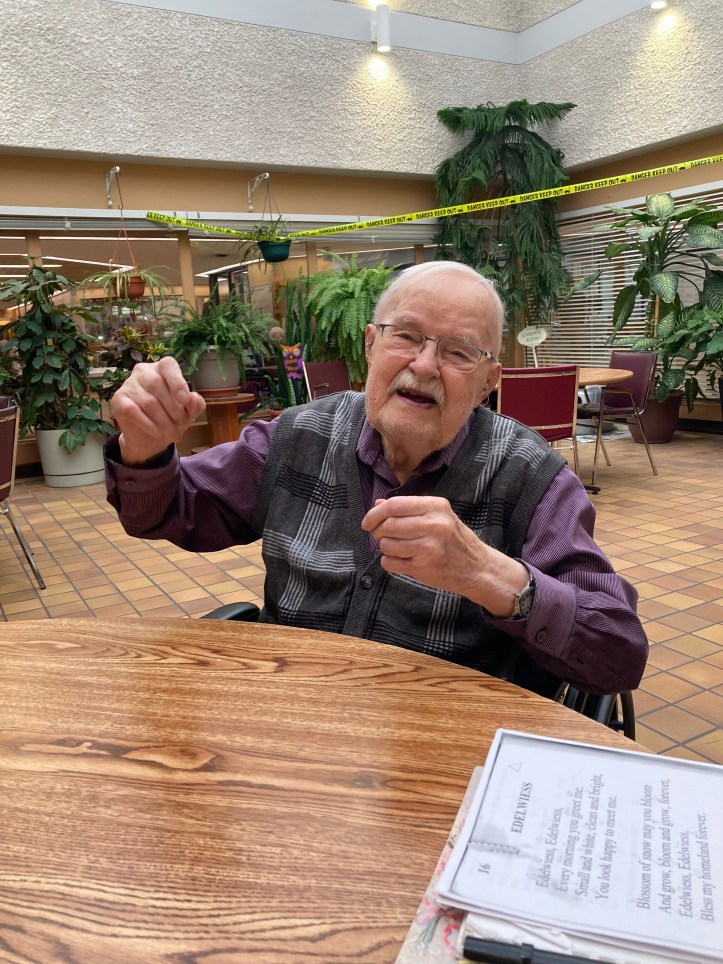
My beloved dad, Frank Sawatzky, passed away on May 31, 2025, at the age of 100 years and 8 months. Here’s the tribute I read at his funeral.
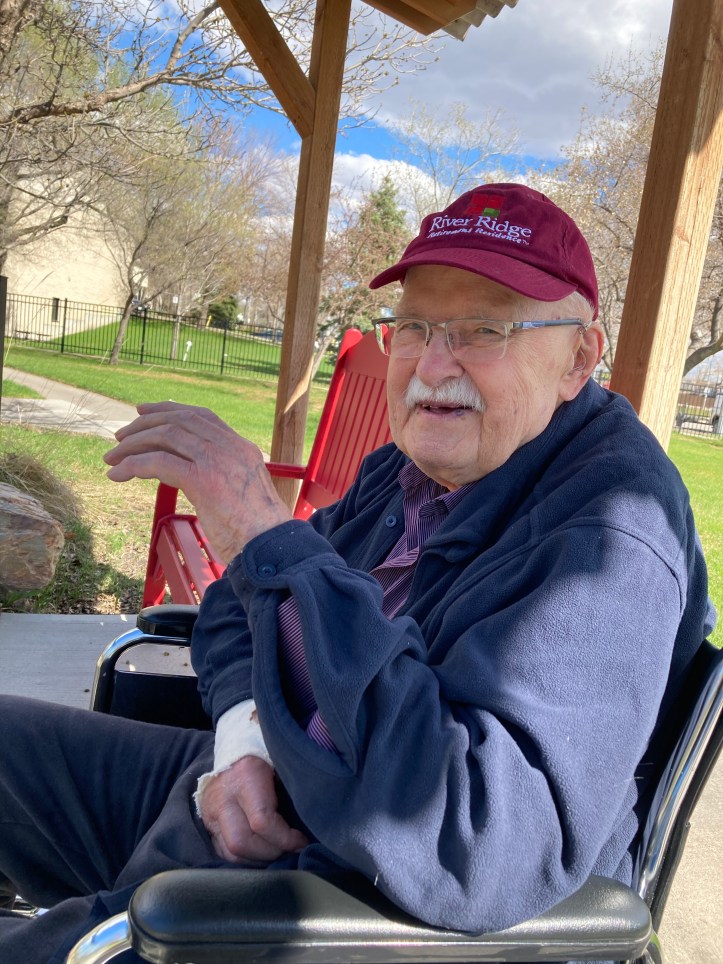
My dad was a remarkable man who I knew on this earthly life for 64 years. The relationship we have to our parents is often a complicated one, and I feel so grateful that I had so long with him, to work out all the twists in the road we had. In the month before he passed, I told him he’d been a perfect dad. I didn’t mean flawless. He had his shortcomings. He could be gruff. He had a temper. That’s probably what he thought I meant, and he protested. “No,” he said and shook his head. “Yes you were dad,” I said, “You were the perfect dad for me, the one I needed; the one God used to help me grow.”
My memories of dad as a kid were of playing. And he was good at it. For Easter, he wouldn’t just hide Easter eggs in the obvious places. He’s undo the curtain hem and place them inside, or unscrew the furnace duct. I don’t know how we found them all. He once made me into a snow person. I stood on an upside down garbage can while he transformed me. One year at a rented cabin in the Whiteshell, he taught me to how to dive by getting me to dive over and over again. He rated each dive with a nickel, or 10 cents or maybe even a quarter. When I reached $5, I learned to dive and I was $5 richer. It was a joyful and creative collaboration.
Coming home from work, I’d comb his hair as he read the Free Press in the tan Lazy Boy recliner on Arby Bay, being careful to avoid the mole on one side. I was a talkative kid, and I’d start chattering right after the Amen of “Segne Vater” prayer at supper. He said I should wait a moment. “How long is a moment?” I asked, and he counted 3 taps on the table. Seemed clear enough to me. He enjoyed my questions, and often told me through my life about the questions I asked him during church, such as why the preachers were yelling.
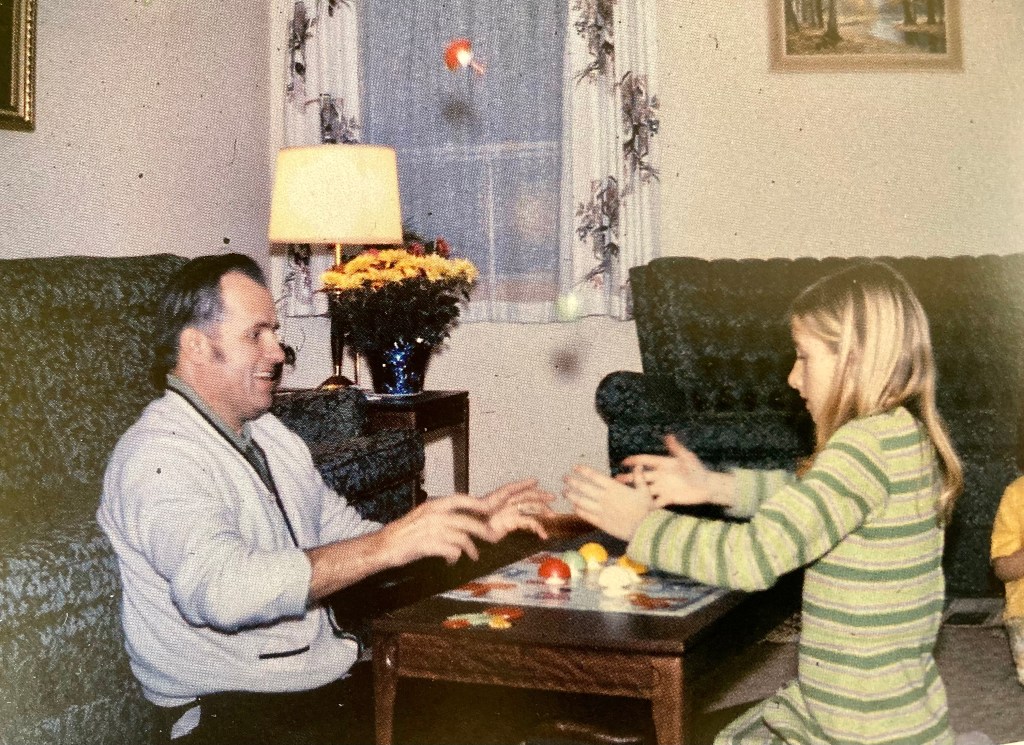
Trying to catch “Hoppin’ Poppies”
(see the red one in the air?)I appreciated all the pets mom and dad allowed. When our budgie Dandy accidentally flew away, we went out looking and found him. When our cat Jello was run over, he got a spade and we went to bury him. I took those events for granted but the older I get, the more I treasure them. Even as a teenager, I still felt proud of him. He was the conductor in the church choir that I sang in. He once asked everyone whether we were on pitch. No one seemed to know. “Well,” he said, “if no one notices, then it probably doesn’t matter.” Everyone burst out laughing. Dad once told me he’d secretly wanted to become an actor, and you could see his charisma at times like this. He loved to recite poems or sayings or sing to people. He loved to quote his Italian barber, who said, “That’s the way it goes.”
While camping, we would go blueberry picking and, ever the adventurer, dad would wander ahead. Suddenly way in the distance we would hear, “Ooo ooo!”, and we answered back in kind to help him find his way. At night, he would tell us war stories in the tent. It was only in my 50s when I realized how much war had affected him, how much trauma he’d had to live through before the age of 25. The gruff side of our dad became more clear to me as I realized the PTSD he lived with.
As you all know, a shadow fell over our family when their oldest, Hildi, died in 1968. Even though the experience had drawn him closer to God, he also lost his faith for a while too. The war years had seen so much loss, and here was another death so soon after entering the peaceful land of Canada. Dad’s gruff side came to the surface more often then. As a teen, I helped him build the cottage at Lester Beach. He was a perfectionist, also grieving, and I was a teen – a difficult combination. If dad said hupps, you had to hupps and if dad asked for a tool, you better bring him that tool. But to this day I am proud of that cottage. He was fair to me too when he paid me for helping, which I later used to go to Israel and Egypt. Another treasured memory of dad was his response when I had my first heartbreak at age 19. After church, he noticed I was down and I told him. He said that sometimes when we’re sad, it helps to move, and suggested we take a drive. He was right, it helped. All the way to Lockport and back, he just listened with compassion. No advice, just acceptance and love. I never forgot that loving attention that only a father can give. Thank you dad.
In adulthood, we entered a difficult time. He and mom didn’t agree with a life choice of mine. These were difficult years for us all, as I pushed back against their pushback. Once some dust had settled, about 10 years later, dad asked to go for coffee at McDonalds and surprised me by asking my forgiveness. We had a good talk that day that did a lot to clear the air.
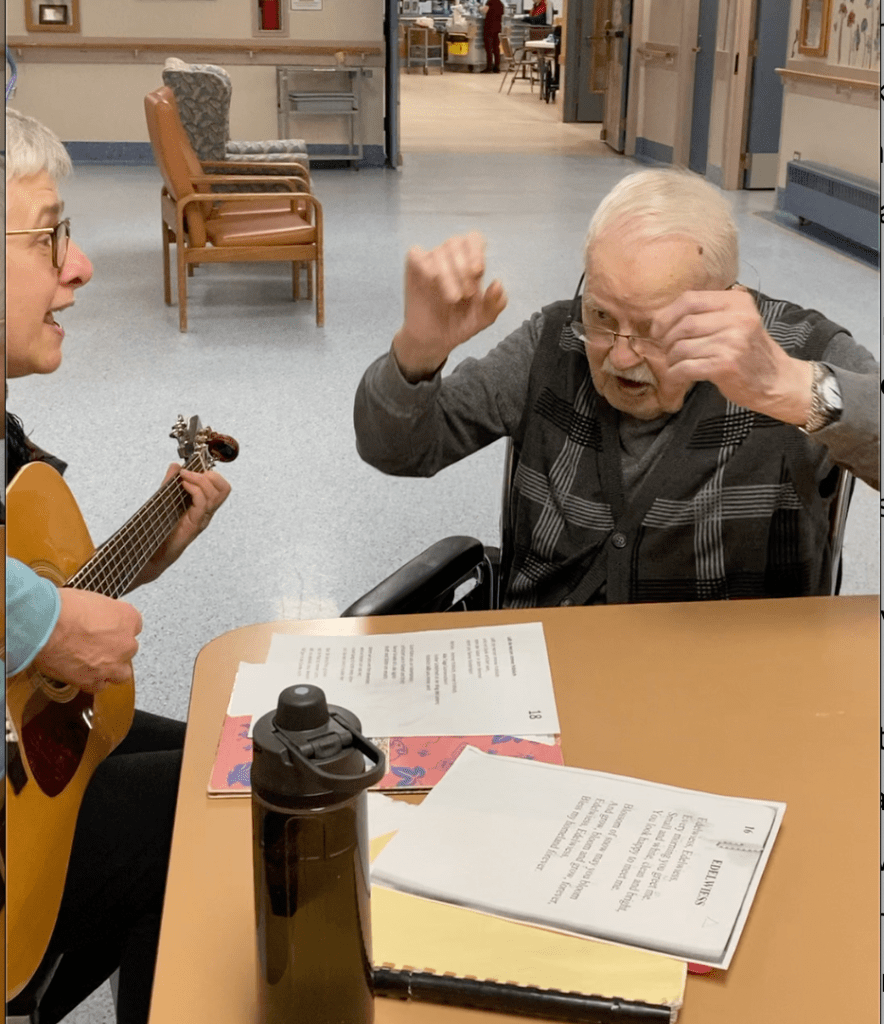
Of all the gifts dad gave me, it was singing together in the last years which became the biggest source of healing. He had given me my first guitar when I was 18, and now music became a bridge between us. At Bethania, his diminishing cognition made conversations challenging, but singing together became a bonding glue. Soon others joined us, and whether german or english, we all went away more joyful as we forgot our troubles, including me. Music healed our spirits. Dad would conduct and sing along. I took pleasure knowing that the conducting was giving him exercise, and the words and music were placing both he and I in the faith that was such a part of his life. He forgot a lot of things, but not the words to songs.
When we sang “Gott ist die Liebe”, (God is Love) he would sometimes shake his head disbelievingly when we sang “Er liebt auch mich.” (“He also loves me”). “Nooo,” he would say, “It can’t be.” Deep down I think he felt, like many of us do, that he was unlovable. Especially now in the years where diminishment robbed him of his strength and dignity and he had no choice but to become dependent. Surely this grace didn’t apply to him. But we kept on singing anyway.
It was just this past February, the day after my birthday, that he unexpectedly gave me the biggest gift of all. We were singing in the front room at Bethania when a health care aid stopped by. “Frank, is this your daughter?” she asked. “What is her name?” When dad finally understood the question, with a laugh he answered quickly. “Her name is Loving Kindness”.
I have pondered this new name ever since. What does it mean? I know myself, and what a mixed bag of saint and sinner I am. I know how often I fail to show loving kindness, especially to those closest to me. I know what an imperfect daughter I’ve been. Like dad, I am disbelieving. Like dad, I’ve thought, “No, it can’t be.” Yet, every time I shared this story, I would tear up at the generous and beautiful name, miraculously gifted despite the cloud of dementia. Sometimes I wondered whether I’d heard right, but I know the health care aide heard it too.
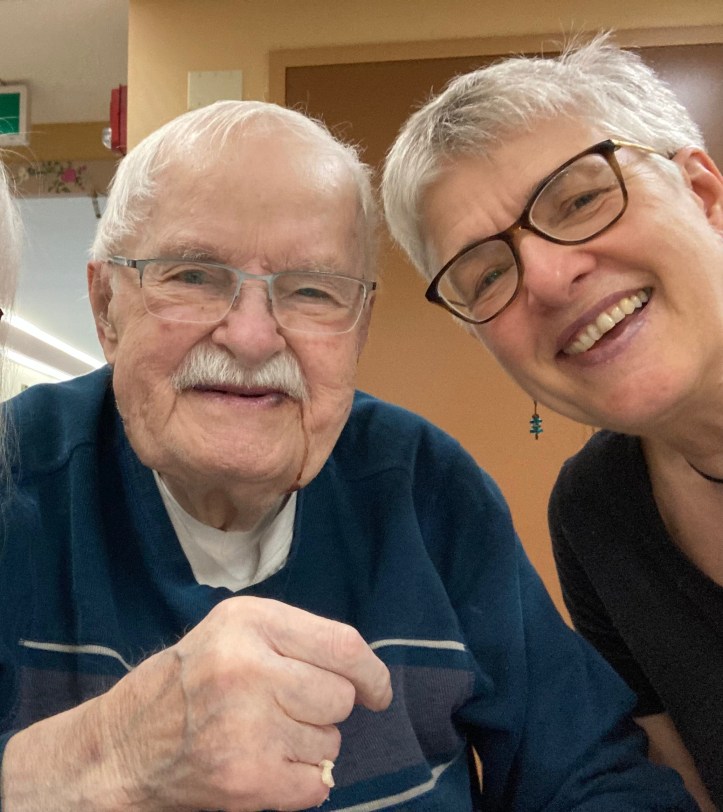
In the months since, I’ve begun to understand why it has felt so powerful. It’s the name God gave me first. I didn’t earn it through good behavior or being a perfect daughter. It is my birthright. Just as it is for all of us, just as it was for Frank. I’m not just the daughter of Frank and Kaethe, I’m God’s daughter. Beloved. Forgiven (even before I know I need forgiveness). My name is Loving Kindness. It’s rude to reject a birthday gift, so I need to accept it.
Dad, dear Dad, thank you for all the gifts you gave me, especially that last one. You too were Loving Kindness to me. Our singing together was such a gift to me. In your liminal time of surrendering your strength and having no choice but to depend on God, you were able to open up to the gift of your true identity. This helped me do the same. I love you Dad. I’ll cherish your legacy always, and if I live to be 100, I pray a joyful spirit will still shine through, like yours did.
-
New Cohort!
Hello everyone. It’s been 7 months since my last
confessionblogpost. A friend from Dallas urged me to write again. Thanks for the push Benz. So I’m back in the blogging saddle with some news. In just 9 sleeps from today, I’m joining a new cohort!Backstory: After my Dallas cohort ended in 2023, I was encouraged to continue learning about contemplation and the Enneagram. I discovered Inscapes here in Winnipeg and took a once/month course last winter/spring. I enjoyed it thoroughly and learned they were part of a larger 2-year course called Prairie Jubilee.
Just as I had with the Dallas cohort, I heard an inner “YES” from God/the universe. After discernment through prayer and with my community, I signed up! It starts on September 27, just a few days away from now. At this time, I’m just taking year 1 (which is actually 16 months), and it’s almost all on zoom, so no more long distance travel. There will be 13 participants across four Canadian time zones with four instructors.
What is Prairie Jubilee? Short answer from their website: “It is a two-year experience in self-development and self-realization focused on the ancient symbol of the Enneagram.” There are 10 weekend “modules” with smaller meetings in between, essays to write guided by a reader/mentor, a silent retreat, plus an assignment called “Journey Groups”. I’ll receive spiritual direction from Carol Ann Gotch, a wise Christian woman who runs a retreat center on Lake Winnipeg. Honestly, I’m not even sure what it all entails, but I trust what I’ve heard so far. My deepest desire is that it leads me more deeply to discover my truest self in Christ. I won’t ever stop wanting that.
When I began this blog, I wanted to call it “the “”The Wannabe Contemplative Blogger” to avoid any impression that I’ve arrived and “above it”, but the title felt too cumbersome. Anyone who knows me, knows this contemplative has a bad case of monkey mind. Many days I feel a bit like I’m drowning and in need of a life raft. Many days I’m riddled with anxiety, skimming the surface of life…hardly a contemplative. But apparently God loves broken people and keeps no limit on second chances. Richard Rohr says that grace is God’s first name, and probably last too. God loves us wannabes.

Thomas Merton once said “With God, a little sincerity goes a long, long way”. I’m bringing my “devotional sincerity” to the table, fully aware that it’s arising out of my poverty. And as Kate Bowler says, “Christian hope is like an anchor that God tosses way out into the future and reels us toward it, part of an unimaginably beautiful yet unseen future ordained and ushered in through Jesus’s saving work.”
I’m so grateful God’s given me another boat to carry me through the next chapter of my life.

Calligraphy by Lydia -
From Trouble to Trust

My faith community is currently studying the book of Psalms. When we began last October, a box of envelopes was passed around containing verses from the Psalms. We were to pick one to accompany us through the course. For my homily in February, I decided to focus on the verse I chose. Only one verse — how hard could it be?
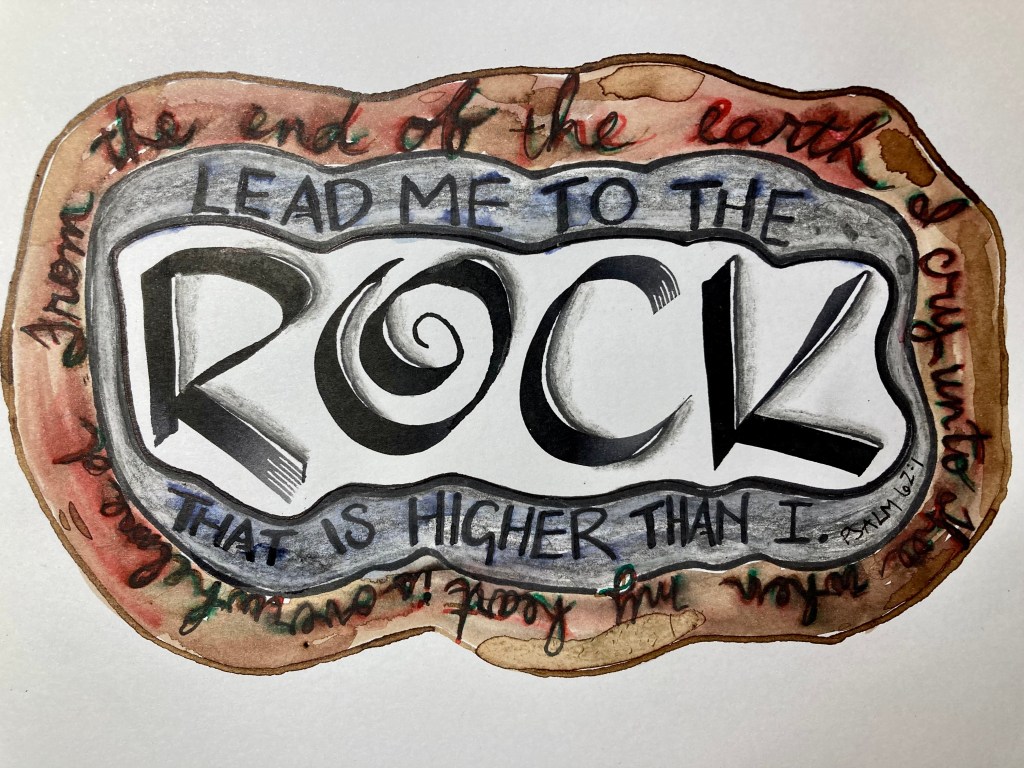
To be honest, I didn’t really like it. It seemed…kind of obvious, like telling someone they should exercise, or drink more water. Of COURSE I’ll let God lead me to that higher rock than I when I’m in trouble. Duh. Isn’t that my life’s intention? What’s not to like? It’s a verse that, for me, felt so familiar I didn’t hear it anymore.
Still, I knew it was time for a second look and allow it to be the prayer I saw my life through. I journaled about it, lettered it in calligraphy, pondered significant rocks in my life, and reflected on the “higher places” God has provided for me. I journaled some more.
After this “creative right brain” prep, it was time to turn to the commentaries and that was when I hit a speed bump. Psalm 61 is not in the Lectionary, and so nothing turned up in the online resources I usually use. A friend lent me two commentaries but they amounted to less than 2 pages on this verse.
This might not seem like a big deal, but it began a time of unraveling for me, becoming frantic and bit depressed. I’d wanted something substantial to say but instead, all I was left with were my own dusty thoughts in the wilderness. The verse was short, just 25 words, and any thoughts of hope or consolation were much shorter. Cue the crickets.
This was mid January and I had still been feeling the afterglow of my cohort, but now its consolation evaporated like the morning fog. I’d needed those myriad resources to guide me and give me something half intelligent to say, but all I had was this ROCK that I was supposed to be led to. It seemed highly inefficient, and like a rock, highly uncomfortable. What was God thinking?
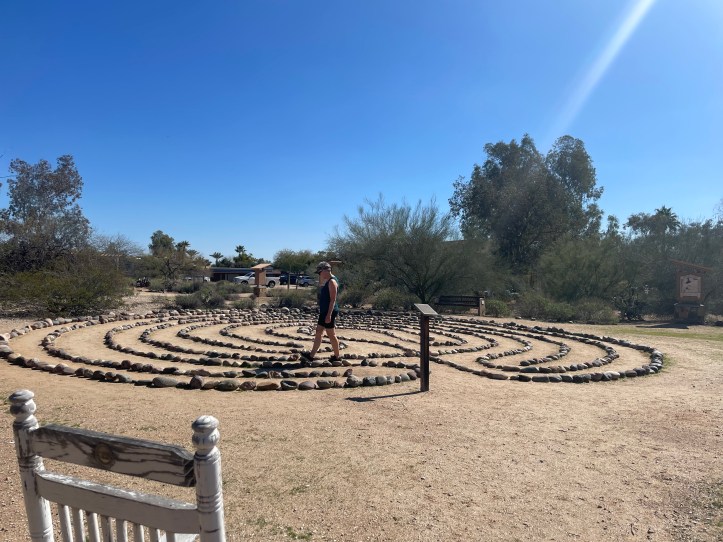
Me walking a labyrinth in Phoenix Psalm 61 is the prayer of an exile who laments his displacement. When he cries to God “from the ends of the earth”, he is at the very farthest point possible from the Temple, his spiritual home. It’s like he’s sinking and is asking God to put him in a place of safety; on a rock that is higher than his circumstances. I thought back to the labyrinth we’d walked in Dallas. Joe had taught that whether near or far, we’re never NOT on the path towards the center, where the beloved Holy is who calls us holy as well. Despite feeling “at the end of the earth”, surely I was still on the journey, on the labyrinth’s outer edges. Have patience, I told myself.
That’s when insomnia began setting in, which made my predicament much worse. Never mind the lack of resources, how was I supposed to prepare with a foggy brain? I felt completely disconnected from God, with a flat affect, off the grid and kicked off the labyrinth. One night I cynically lamented to God that the sprouts of new life from the cohort now seemed like a cruel joke. This mythical rock didn’t just seem remote and distant, it felt non-existent.
I hesitated to share this in my homily. Surely my suffering pales in comparison to the suffering in our world today. My infrastructure is still sound, who am I to lament with the psalmist who probably had it way worse? Was God just hearing the whining of a privileged pilgrim? My white guilt only added to my sense of lostness. From the end of the earth indeed, with no idea which way home was.
I realized I’d been reading the verse with a bias. The way I usually operate is, “When my heart is overwhelmed, I’ll head on over to the rock that is higher than I.” I’ll read a book, listen to a podcast, exercise… but all this implies agency and control on my part. I had none. I had no idea how to get to that rock. Like the exiled pilgrim, I felt far away. I was crying out but nothing helped. I couldn’t see God my rock in sight.
In C.S. Lewis’ classic parable, The Great Divorce, the experience of hell is a grey city. The inhabitants live an increasingly joyless and friendless life as they move further and further away from their neighbors. They can escape this grey hell anytime though. Every day a bus is ready to take them to a better place, but there’s a catch. They have to let go of their own security and accept their reliance on the guides God provides (which is both a painful and healing process in the dream that forms the book). You’d think this is a small price to pay to get out of hell but most sullenly either remain or return to this increasingly private hell which they choose instead of heaven.
This described where I felt I was. I knew there was a bus out but I felt stuck on one of the bends on the labyrinth’s winding path. I know everyone is familiar with being stuck. Not just in our outer circumstances, but the hell inside the hell where our mind and heart knows no peace.
Years ago during a study of the book of Revelation, I learned a helpful phrase, “I turned and I saw.” The writer, John, turns and sees…a voice of someone speaking, or a door, or golden lamp-stands. And somewhere in my plight, I turned and saw something that broke the spell. “I turned and saw” the psalmist’s lament during one of our study nights, though it took a while to sink in. “Please God, no more yelling, no more trips to the woodshed,” pleaded the Psalmist. “Treat me nice for a change…if you love me at all, get me out of here!” (Psalm 6 Message translation).
The lament woke me up to my predicament and helped me voice my despair to God. Lying awake (yet again) that night, I thought of Christina Robinson’s paraphrase of my verse, “I call on you from the end of my rope — hanging there with a heavy heart. HELP!” After hours of tossing on the couch, another verse from the our study’s lament came to me, “Get out of here, you Devil’s crew!” (6:8)
The psalms are rich in talking back to our enemies. Whoever we are, enemies always want to reduce us. The Message translation sure got it right, it was indeed a Devil’s crew stealing my life, trapping me in this hell of the grey city. I saw myself lying there with a frown and Psalm 6 gave me the nerve to talk back to the crew.
“Get the f**k out of here!!” I yelled. “Leave me alone! I want my life with God back.” (“Please God, no more yelling, no more trips to the woodshed. Treat me nice for a change!… 6:1-2).

I called my homily “From trouble to trust”, and I think it was this moment of utter desperation and anger that finally got me unstuck from my trouble. I turned and saw and God led me to the rock. Sleep came, and in the morning my flat affect turned to tears.
Throughout the cohort last year, Joe Stabile had told us that “surrender” was the essence of every religion, and of our year. That anger against my inner enemies was a cry of surrender, and behind it lay my prayer. “Break in, God, and break up this fight…if you love me at all, get me out of here. I’m no good to you dead, am I?” (6:4-5)
The lack of resources for my homily was the best commentary God could have provided. It led me into a desert which I now see was provisional. I realized that I’d been feeling sorrow at the loss of my cohort. The consolation of it was gone. I was no longer looking forward to another trip to the beloved Micah Center. The connections I’d experienced there, with the help of our wise teachers, were over. The temple seemed far away but what was worse was I didn’t feel something similar here. I’d wanted to be transformed, on top of things. Instead, I felt like the psalmist, like I was still at square 1, a kid lost at the park.
God gave me a place to live again, a place of refuge. I knew my laments were heard when Lyle came upstairs with a consoling hug and the assurance I’d get through this. When I wanted to buy earplugs at the pool later that day, all they had were children’s earplugs. “They’ll work for you,” the pool staff told me, and it seemed a good echo of my childish surrender. And inexplicably that day, my childhood 2nd mom, “Tante Bargen”, phoned just to tell me she was thinking of me and that she loved me. Once we’re on the rock, doesn’t everything seem to be a gift? I realized I was loved, not for some fancy words in a homily, not when I had it together, but in my unfixed state.
The rock higher than I is just a place of complete dependence. I didn’t know that, like the psalmist’s bed, it too could be soaked with tears. I’m glad God reminded me that crying out can include swearing at our enemies.
Can I trust that my journey isn’t over even if the cohort is? Can I trust that God is still healing me? Leading me to a higher place? Leading me to find the fulfillment I’d felt in Dallas even here? Maybe I didn’t need to DO anything to get there other than utter dependence and trust.
God has seen me through so many trials, inexplicably holding me together when I’ve cried out, keeping me alive in ways seen and unseen. Why wouldn’t it be true in 2024? As Rev. Jeremiah Wright, a black preacher, said, “You can’t keep down what God wants up. God never fails.”
Labyrinth art by Bev Patterson -
Walking the Labyrinth
And just like that, the cohort year is over. The last airline boarding pass has been scanned and hotel key handed in, the last hugs with newfound friends were exchanged, and with some sadness but also ok-ness, I walked away, probably for the last time ever, from the beautiful Micah Center.
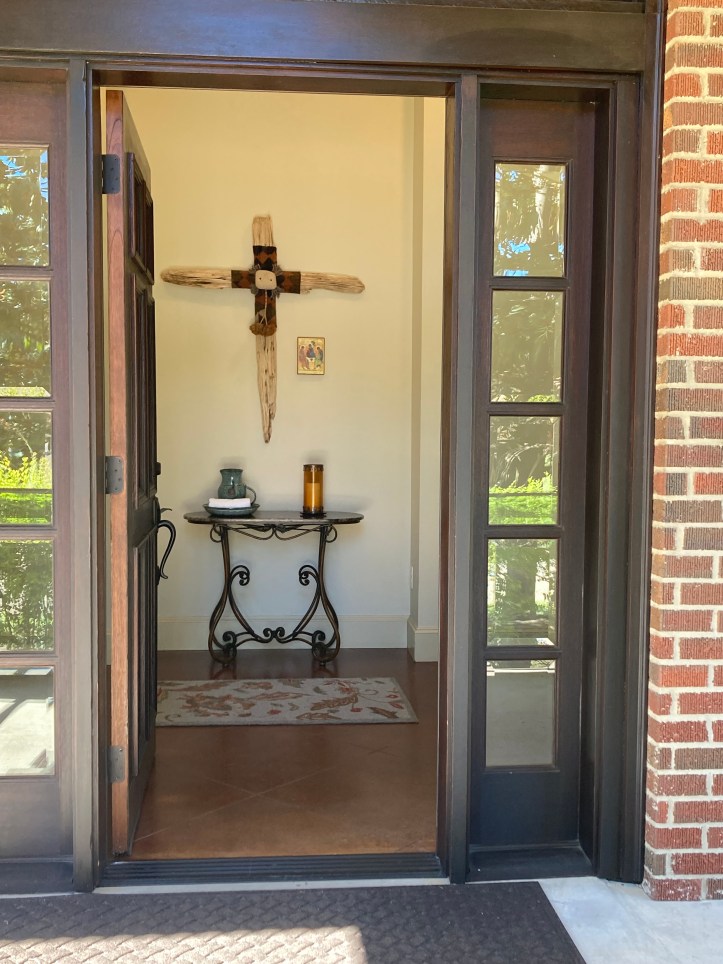
Entering the Micah Center I’ve been back home for over five weeks and already the whole year is settling in like a dream. Life here has resumed with all its usual joys and complexities and busyness. So many things to do. But my time with the cohort – a year of resting in “not-doing” – remains within me like a jewel I turn over and over in my mind’s eye. Like Mary I have been treasuring up all these things and pondering them in my heart.
A hero on a journey returns to the community with a boon that benefits everyone and I wonder…what exactly is the gift I was left with? What was the journey for? After a year of concurrent spiritual direction in Winnipeg, I’m more aware than ever of areas of my life in need of God’s healing. What has this spiritual beginner brought back?
On the last day, I was feeling full and blessed by everything when a shadowed thought struck me. “What if conflict seeps into my life again?” I flinched, especially as I remembered “the” conflict. Frederick Buechner says life is always terrible and beautiful all at once, and I knew I was not immune just because I have a new toolkit of spiritual practices. But as quickly as the shadow arrived, a reflexive assurance came in its place, that God would be present there, just as God had been present through everything in the past year. God lies at the interface of suffering and hope, always.
I’ve since been grateful for that moment because of course, life is life and as author Kate Bowler says, everything happens. Not just the feel goods. (Why do I keep being surprised by this?)
Fridge magnet a friend once gave me We received our last spiritual practice on the final day of the cohort when we went on a field trip to walk a labyrinth together, located in the gym of a local church. Once we got seated on the bleachers, Joe taught us that labyrinths were originally designed for those with neither the time nor resources to go on a weeks long pilgrimage. It is meant to be walked slowly and prayerfully. Like our lives, its winding path has unexpected bends in the road. At times a person will be far from the center and at times close, only to walk far away again. But, Joe said, we are never not on a path leading to the center, to God. While a maze is malevolent and tries to trip you up, a labyrinth is benevolent. Whatever our twisting lives look like, we are always journeying towards the heart of God.
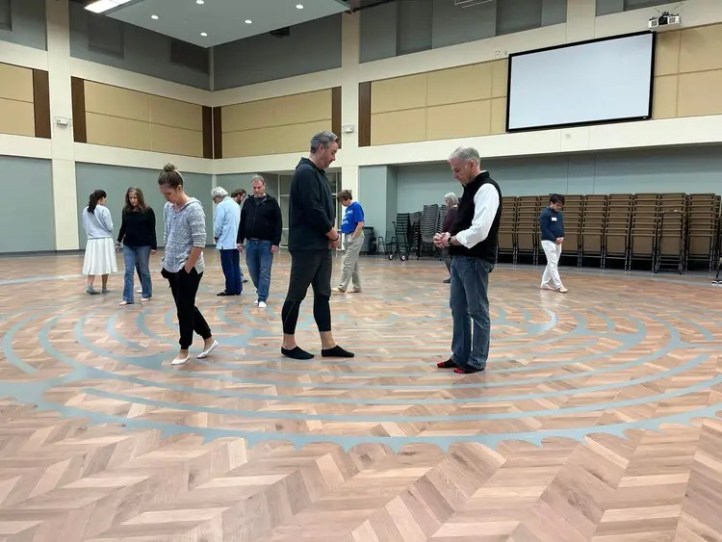
As I entered, I was aware only of my bare feet on the cool floor. Was I walking too fast? Too slow? But the silence in the gym began to work on me. Alone with my prayers and thoughts, I began to sense gratitude for all that had brought me here. Every airport worker, the hotel omelette lady, my teachers and cohort friends, friends back home who were praying for me, my husband who supported me in so many ways to get here. I sensed gratitude even for the conflict. As painful as it was, God had not left me bereft but had filled the hollowed places with unexpected miracles and most of all with a growing sense that I am beloved of God.
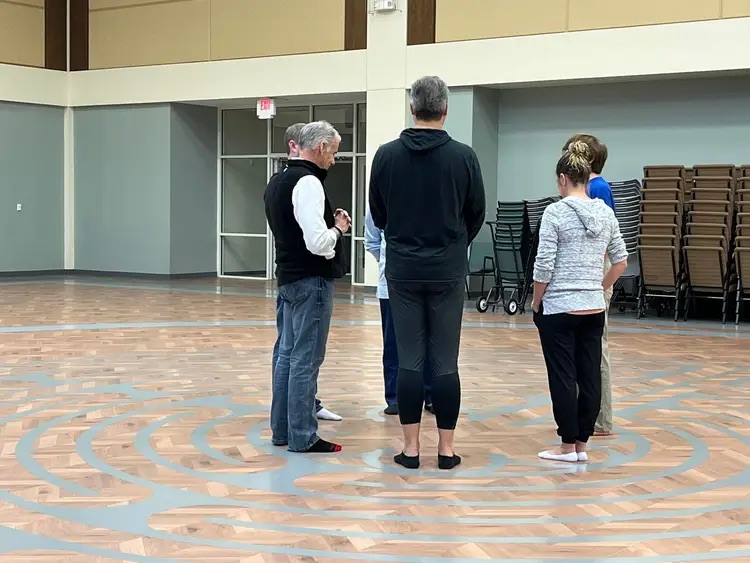
Just as Joe had promised, all the twists and turns faithfully led to the labyrinth’s center. I’d never noticed this before, but there are pockets, like the petals of a flower, meant for pilgrims to pause before the journey back out. I stood with my friends in silence that felt sacred. I hadn’t expected this moment to strike me so deeply. I didn’t want to leave.
As we debriefed afterwards, one cohort friend broke down. She had realized on her winding walk just how exhausted she was by a bend in the road that lay ahead for her in coming months. She lost her words and just shed tears. One by one people got up to sit with her in her grief, laying our hands on her and one another. Joe said a prayer. Another holy moment.
I’m still not sure all that my year’s pilgrimage has wrought in me. But one thing I am confident of. No matter what, the labyrinth is true. Even when we find ourselves on life’s outermost edges, we are all on a journey to the heart of God. As Joe kept reminding us all year, there is nothing we can do that can make God love us any less.
Perhaps what I’ve brought home with me is a deeper awareness that this is true. Like the tiny acorn that Julian of Norwich took with her into her anchorage, it doesn’t seem like much at first glance. But it contains the whole world.
That’s a souvenir that money can’t buy.
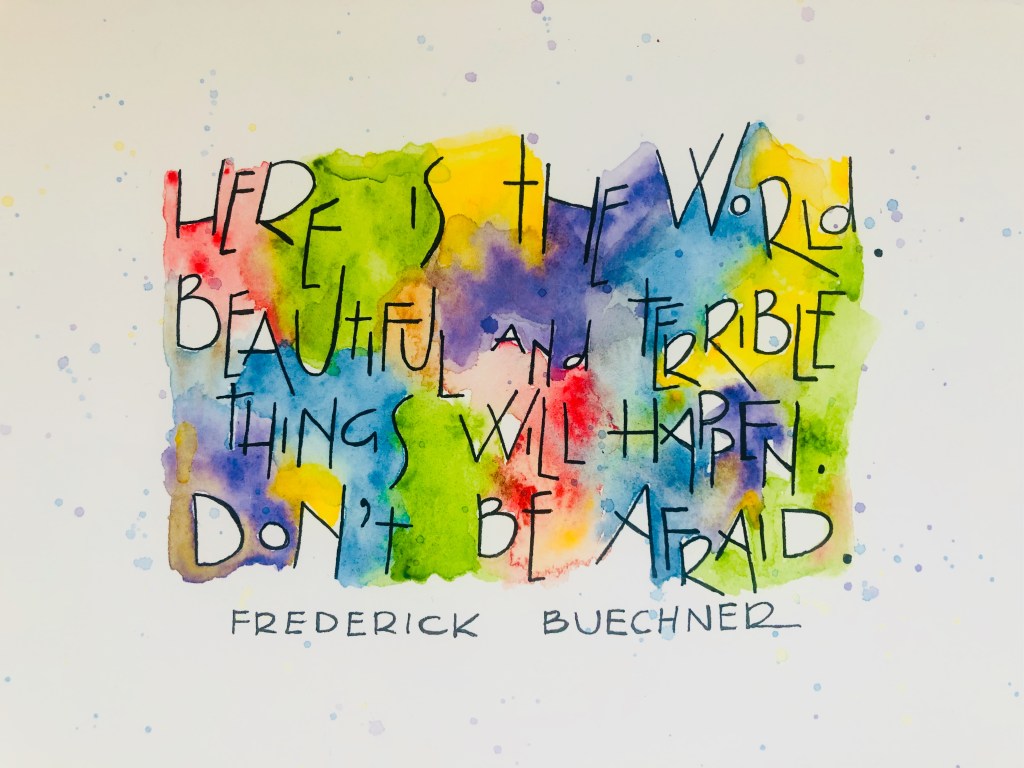
Calligraphy by Lydia -
My old friend the blues
It’s been over three weeks since August’s Cohort #3 has come and gone. Despite it being as rich and full as the first two, I became a bit depressed since coming home – a visit from “my old friend the blues” as Steve Earle sang. Like most of us, I’m no stranger to the blues but this visit hung on like the burrs my cat got covered in the other day. It was difficult to begin a new blogpost as the inner critic (aka my 1 wing) started getting all judgy (“Shouldn’t you be just a *bit* more transformed by now?” and the ever helpful “Ya call yourself a contemplative?!”), but since the old writer’s adage says, “Write what you know”, I may as well start with this admission.
In my previous life as a grade 3/4 teacher, the biggest highlight of the year was always the field trips, when we got to leave the confines of the class. Excitement began to build in the weeks leading up to whatever pilgrimage lay in store. I’d collect permission slips and money and teach topics from a new perspective. These were inner city kids and it was easy to dream big as hope for a better life was kindled in us all. Finally the Big Day would arrive — Freedom! We’d walk past other classes slouched sadly over their desks and proudly climb aboard the magic school bus.
Over the years I began to notice how unfailingly, spirits began to sag after lunch and the trip back to school was usually quieter. Kids got more irritable with each other. All that buildup and now it was over already. Had our hopes been too high?
It occurred to me that maybe my September blues after the third cohort were like the after-lunch feeling. The analogy fit in several ways.
Being accepted into the cohort back in November 2022 initiated that same field trip feeling. During a difficult year, it gave me something transcendent to look forward to — a possibility that my chunk of coal could transform into a diamond. Sleepless nights? More than one bewildering conflict with me spinning in disorientation? The mantra that kept me going in the dark times was, “I’m going to Dallas.” I’ll admit it had a tinge of “Get the hell out of Dodge” (thank you Gunsmoke). But still, my pilgrimage has not disappointed. The cohort’s teaching has provided a trustworthy path through the troubles. Thanks to Joe Stabile, Hunter Mobley and newfound friends, I have a developing toolkit of spiritual practices. My tight clutch on expectations is releasing to God’s gentle nudge. I’m sleeping better and best of all, healing has begun in ways I couldn’t have planned. A year ago at this time, I could not have said that.
So why the long face?
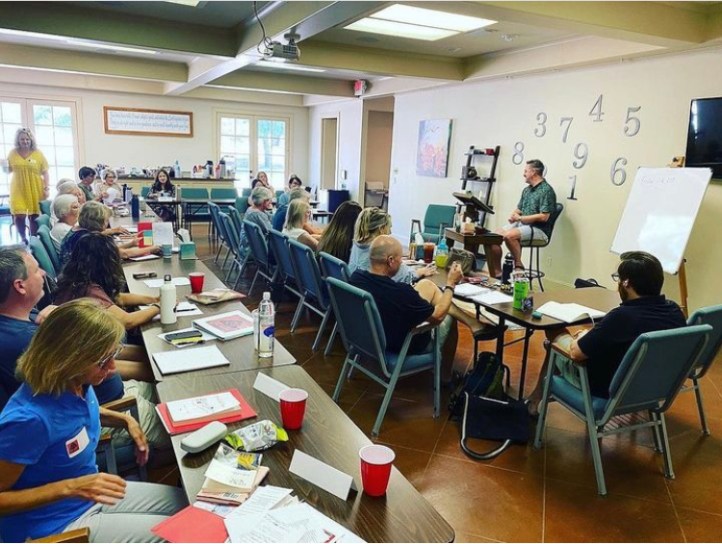
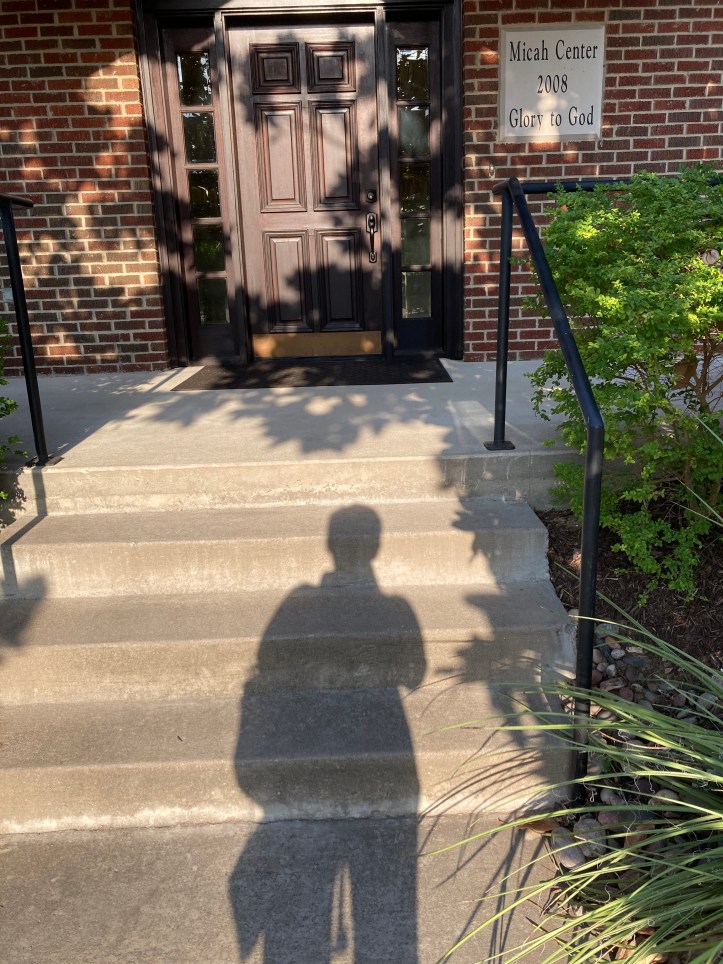
The Micah Center field trip ❤️ The Welcoming Prayer reminded me that whatever comes to us in each moment is for our healing, and I began to relax. Maybe it was OK to be feeling down. My students unfailingly felt it so why shouldn’t I? Maybe it was also the sadness of the coming end of the cohort in November. I realized that the after-lunch feeling created an illusion. Good-byes in Dallas won’t mean good-bye to transformation (or even to future pressures on all my many remaining lumps of coal). My 6-word Centering Prayer intention “to be totally open to God” doesn’t have a clause at the end which says “during dramatic times only”.
My spiritual director wisely gave me some verses to meditate on during this time. As I’ve committed them to memory, God has breathed new oxygen into a gloominess I thought was permanent.
Don’t run from tests and hardships, brothers and sisters. As difficult as they are, you will ultimately find joy in them; if you embrace them, your faith will blossom under pressure and teach you true patience as you endure. And true patience, brought on by endurance, will equip you to complete the long journey and cross the finish line — mature, complete and wanting nothing.” James 1:2-4 (Voice translation)
Maybe it’s time for a new mantra. I’ll need a new one for the next sleepless night after November anyway. Maybe “I’m going to Dallas” can change to “Open that toolkit”. God has been faithful in past dark moments, so why not future ones? I’m learning that each moment, high and low and everything in between, is one that God the eternal improv partner can work with. Scientist and theologian Ilia Delia wrote, “Heaven unfolds when we see things for what they are, not what we think they should be, and when we love others for who they are, and not what we expect them to be.”
As for that inner critic who expressed shock at my sagging spirits, I’ll take Ilia’s advice and love her for who she is, imperfect, becoming, unshakably beloved.

Magnolia flower seed pod from the Micah Center -
Enneagram Passions & Virtues
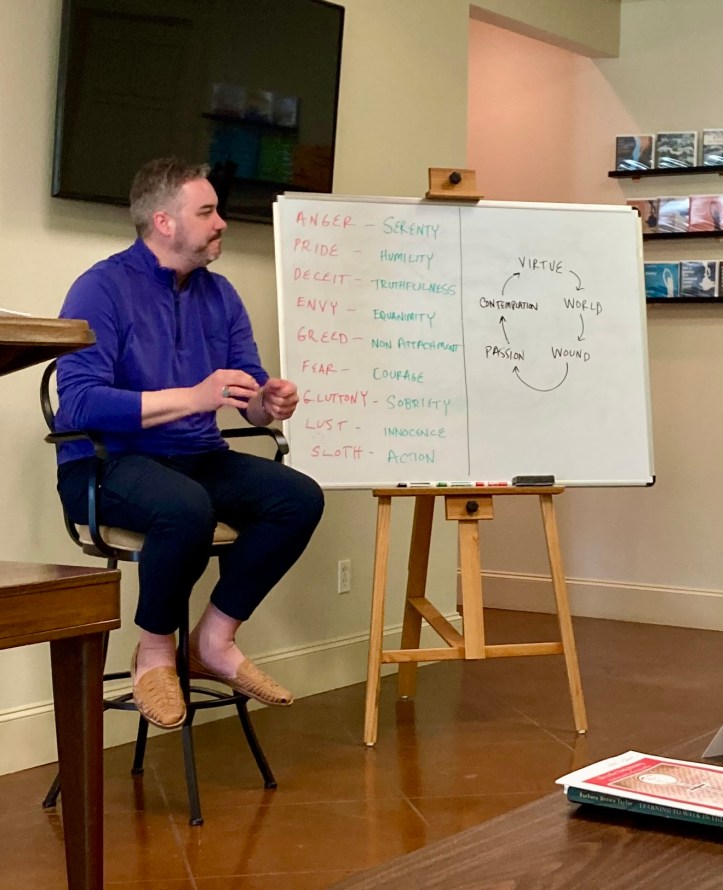
Each time the Contemplative Cohort meets, we receive an Enneagram teaching from Hunter Mobley. As we go through the year, I’m understanding more how well these two components – contemplative prayer and the Enneagram – work in tandem and dovetail together. Each has to do with surrender to God. If only surrender could happen as easily as taking notes! But as we were reminded at the end of our session, “This is wisdom, not information.” No quick results in Enneagram or soul work.
At our April cohort, Hunter began by talking about each number’s passions and virtues. You can’t talk about the one without talking about the other. They’re two sides of the same coin; opposites but also paradoxically connected.

Stuck on the roundabout In Enneagram-speak, passions are the traps everyone falls in to; where our false self or ego is. To use a recent metaphor from Suzanne Stabile, it’s like our passions get us stuck on a traffic roundabout and we can’t find the exit. Passions are sometimes referred to as our sin. In fact, the passions are the seven deadly sins, plus two (deceit and fear). We struggle with all of them, but one is especially unique for each of us. The virtues on the other hand are the things of the soul — part of our essence and the true self which originates in God.
Some passion/virtue coins are easy to understand and some are more nuanced. They are:
- Anger & Serenity (1)
- Pride & Humility (2)
- Deceit & Truthfulness (3)
- Envy & Equanimity (4)
- Greed & Non-attachment (5)
- Fear & Courage (6) (Hunter prefers the words Anxiety & Faith.)
- Gluttony & Sobriety (7) (Sobriety can also be defined as moderation and satisfaction.)
- Lust & Innocence (8)
- Sloth & Action (9)
Your virtue, said Hunter, is truer than your passion, but it’s not what usually gets expressed to the world. The things that are hardest for us and frustrating about us to others is not what is truest about us.
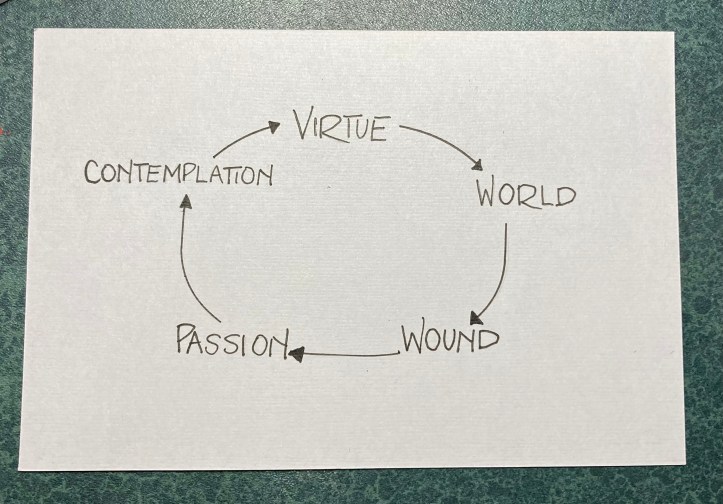
We spent some time on a helpful diagram. Our virtue, said Hunter, is what we come into life with. It represents the deepest, truest parts of ourself; the God image that we bear. But then, the world happens and we all get wounded by the world. Hunter said it happens early. Life experiences, childhood wounds, nature and nurture, all come together to build our personality. Our personality becomes like layers of an onion that begins to protect and hide that beautiful gem of the virtue we were born with. The wound of our childhood gives birth to the passion.
Tracing my life back to its beginnings, I can see how my passion began. I was the youngest in a family with war-affected parents and when I was 7, a family grieving the loss of the oldest daughter to leukemia. To boot, it was the 60s when children were still to be seen but not heard. Outwardly I was a happy kid but also perceived no one was really interested in my feelings and needs. When my oldest sister died, no one talked about it, and many years later my mom talked about how lonely those years felt.
And so I learned to get positive strokes by being helpful and “nice”. To find love and belonging, I learned to be attentive to the feelings and needs of others — always “other-oriented”. It’s not as holy as it sounds, then or now. My survival strategy came at the cost of being truly myself and admitting my own needs. Pride set in, which Suzanne has defined as the “inability or unwillingness to acknowledge one’s own needs and suffering while tending to the needs of someone else.”
Everyone moves from childhood wound to their passion in their own unique way. I’m certainly not alone. The older I get, the more clearly I can see how perniciously this pattern continues to grip me. The subtle ways I become ashamed of my weaknesses and resist being vulnerable with those closest to me as I try to appear good and “above the parade” of life. It leaves me living from the outside in, willing to conform to or please others but radically out of alignment with my inner wisdom and what I feel is true.
I remember being in grade 7 and being utterly confounded by the question, “Who am I?” My friend and I had a pact to “Be Yourself” (B.Y. for short) but once the deal was made, I had no idea how to pull it off! It was the first wakeup call which many years later would set me on the “road back to you” as Suzanne’s book title aptly puts it.
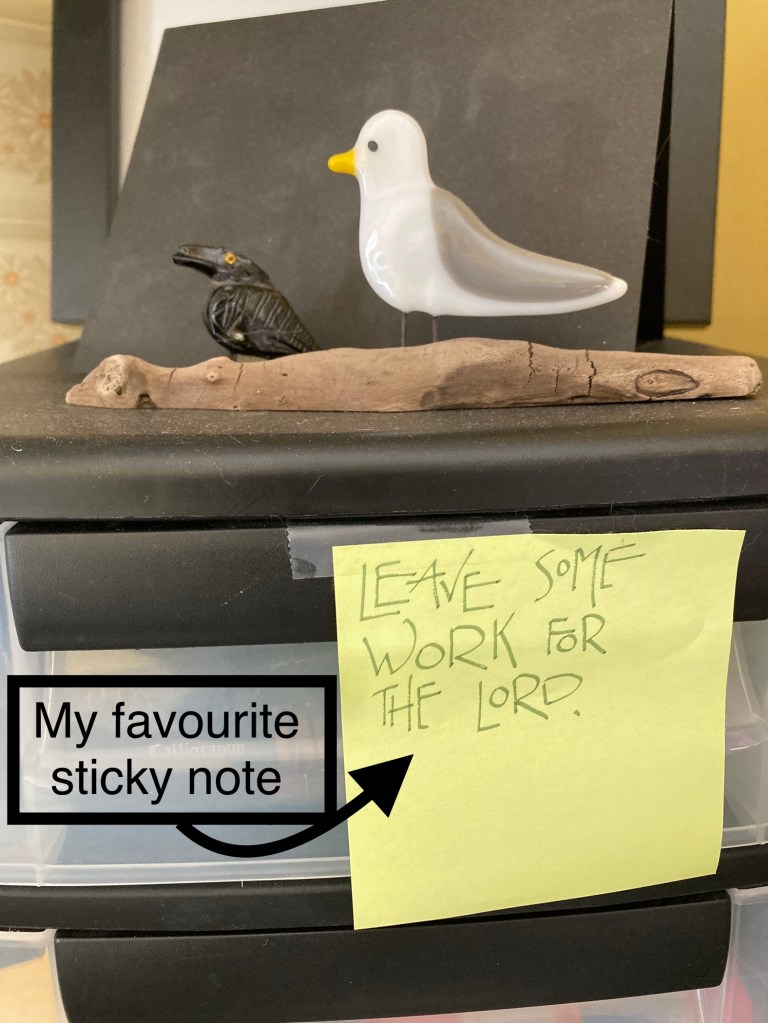
For me, acknowledging that “I don’t need to be helpful and befriend everyone” always feels like an alarming concept at first. But it’s the beginning of the wisdom journey. My friend Cal, who’s also an Enneagram 2, has a motto which I love, “Disappoint one person every day.” I love it because it helps me say no when I need to. Pride says everything is mine to do, but humility urges me to “Leave some work for the Lord.”
As Hunter’s diagram shows, a life of contemplation and connecting back to God our source is the only thing that can take us back to virtue. The love I’m craving when I reach out to others is only found there. It’s there that our spiritual work begins, where we can dismantle and shed the ego and the layers of passion around our gem of virtue. If we enter the door of contemplation, we not only find our own virtue but we enter the room of ALL the virtues. It’s a tricky journey because we can’t will ourselves to virtue (just as an apple can’t ‘will’ itself to ripen, as Thomas Merton once wrote). Hunter said a helpful phrase — it’s like we have to “re-catechize” or re-instruct ourselves.
What exactly does a “life of contemplation” mean? On my first flight to Dallas in January, when people asked where I was headed, the words “contemplative cohort” were often met with a blank stare. To be honest, I stumbled over my words, not knowing how to describe it without sounding like a Jesus freak. Were they imaging I’d be spending hours levitating in silent prayer, divorced from my humanity? I remember trying to translate my purpose to a businessman — “I want a life of meaning and depth.” Again, a polite but blank stare as he turned back to his spreadsheet.
Despite my hesitant words, I still want the life I told the businessman. I have my early wound to thank for pointing me back to my desire for God. Thanks to many gracious gifts (teachers, good friends, youth leaders, the faith community I joined in my early 20s, and even vocational and health difficulties), this journey inward has been the through-line of my life. Hunter reminded us that we’ll always be a beginner on this journey, but that’s infinitely better than being stuck on the roundabout.
-
Five Kinds of Boats
We’re at the lake this week and with my “city agendas” set aside, I’ve finally cleared some time for another blogpost. On the first morning I went for a bike ride along familiar roads, but this time I noticed something different — little trails here and there leading into the woods. How had I never seen these before?
This was a good lead-in to today’s topic, another aspect to Centering Prayer that Joe Stabile taught at April’s cohort. It’s all about the many trails we meander off to during Centering Prayer, but the word Joe used was boats we want to explore as they float down the river. Originally taught by Father Thomas Keating, they represent all the thoughts that arise during a 20-minute contemplative sit. Whether they’re tiny paper boats or huge ocean liners, each tempts us to climb aboard and inspect the cargo.
I’m so glad Joe taught us to expect them. In particular, he described five kinds of boats.
- Wool gathering — The dictionary definition of this is idle daydreaming. It originated in the 1500s from the literal act of gathering sheep wool that was caught on bushes or fences. It must have looked like seemingly aimless wandering. A modern example of this distraction are the dust bunnies that float around on the floor, especially when you have pets. They move around with the wind or the air conditioning. It’s the vague, meandering, whimsical mind that roams through lists and categories — all the things you’ve been thinking about and wanting to do, or thoughts that just come and go. By nature I am definitely prone to wandering thoughts, so I recognize this boat.

Boats at Lester Beach – photo by Lyle - Attractive thoughts — These are thoughts that have an emotional hook. They catch your attention. They tempt us to linger and then we’ll get back to our centering prayer (promise!). An example might be a tense encounter we’ve had with someone recently, and as our mind remembers, the feelings of anger (or whatever it is) start to rise again. The human tendency is to want to mull it over some more. When those kinds of thoughts come up and hook us, Keating says, let them go.
- Self-reflection — Joe said this will drive you crazy if you let it. Ones on the Enneagram are more prone to this, but I can totally relate. Thoughts like, “Am I doing this right? Am I still? Is that a thought? I think it was a thought. Have I let it go yet? Is my breath right?…” To all these thoughts, Joe said, “You cannot let your cataphatic self watch your apophatic prayer.” In other words, our cataphatic self (which uses words, images and thoughts) wants to watch and analyze but it’s not why we sit. Centering prayer is apophatic and is all about emptying the mind of words and ideas and simply resting in the presence of God. In my experience, letting go of these boats is constant, but that’s why Joe told us it will always feel like work.

Me navigating the reeds at Falcon Lake - Thoughts from the unconscious — Joe began describing this boat by reminding us of our intention of consenting to the action of God. We’ve opened ourselves up to the activity of God. But what do we do when something “important” seems to happen? A person might feel dizzy, weird, or have tears. Some raw feeling might come up. Hello! We learned that in those moments, God is doing some rearranging and releasing within you but the temptation is to begin to wonder about it. As Joe reminded us often, what’s happening is none of our business. We don’t need to know, and anyway, the soul’s transformation is not our job. I’m not running the show. We can let go and simply remember we’re in good hands.
- Spiritual materialism — The fifth boat is lengthier to describe said Joe and poses a bigger challenge for us. A good way to understand it is by examining how most of us go into silence — for some kind of insight, illumination or intercession. We think, “If I just get really quiet and shut out the distractions around me (heck, I’ll even travel to Dallas!), then maybe I’ll hear God’s direction.” We come by this honestly because we’ve been taught that silence is the backdrop to listening for messages from God. After all, isn’t the Bible full of examples of God speaking, whether it’s a still small voice or thunder from a mountain? It’s not that this is wrong, but the goal of Centering Prayer is different. It’s really hard to erase this cataphatic programing from our hearts and imaginations.
But what happens when something does happen in those times? The other day I found tears streaming down my cheeks. What was I to make of it? Joe described that sometimes, something emerges into form. Maybe it’s tears, or a psychological or spiritual insight, or a discernment we’ve been waiting for. Maybe a key sermon sentence comes up.

My friend Mel trying out her new SUP on Lake Winnipeg The answer — Let it go. Whatever it is, let it go. It could be a deeply devotional or mystical experience, like where we’re stirred to pray for someone, or a vision. But as with every boat, we are asked to let it float on by. Joe said he’d never ask us after 20 minutes, “What did you get? What did God give you?”
Letting go might seem harsh or wrong. Haven’t we been taught that’s what silence is for? Don’t we need our daily bread? Joe assured us not to worry. A genuine insight will come back in conscious form. Apophatic prayer is sacred space, and it’s sacred for God too. God’s not going to tease us.
We have to remember that the ego abhors a vacuum and it will try to fill it up anytime it feels that. If you give in to it, you end up in cataphatic prayer, and it’s never worth the price. By your willingness to stay in apophatic prayer for 20 minutes (letting go), you are creating an atmosphere that will protect and carry you all the way.
The antidote for spiritual materialism is the attitude of spiritual non-possessiveness. In the desert, Jesus could have changed all those stones into bread but he didn’t. He didn’t hold on to the power that he had. Our natural inclination is to grab on and build ourselves up but spiritual non-possessiveness lets go instead.
Cynthia Bourgeault (another teacher) writes that Centering Prayer is a little bit like learning to see in the dark. When we arrived at the lake on Sunday, I noticed a night light in the bathroom. During the day when the cones in my eyes were active (photoreceptors which are highly attuned to the light), this faint light hardly seemed like it would be adequate so I had my iPhone flashlight ready. But it was way too bright. At night we rely more on our rods which perceive light more subtly, and the room and even hallway seemed bathed in ample moonlight. Bourgeault always considered it a fine piece of synchronicity that “the normal length of time required for our day vision to give way to night vision — 20 minutes — is exactly the length of time recommended for a period of Centering Prayer.”
As my vision changes, remembering about the five kinds of boats has been invaluable these past months. Joe’s teaching reminds me that I’m not alone. All I’m invited to do is rest in and consent to the presence and action of God. It’s both the easiest and hardest thing I’ll ever do.
The chief thing that separates us from God is the thought that we are separated from God. Thomas Keating

Tiny me with tiny Lyle at Victoria Beach – photo by Wade Kovacs -
The Welcoming Prayer
Just before we ended cohort #2 in April, Joe introduced us to our second spiritual practice — the “Welcoming Prayer”. “Oh good,” I immediately thought, “I know this one!” I’d been introduced to it on Suzanne’s recording on the Enneagram and Grieving the previous summer. I’d memorized it, recited it often and even made fridge magnets for everyone in my house church. I thought I knew all there was to know but April’s teaching deepened it.
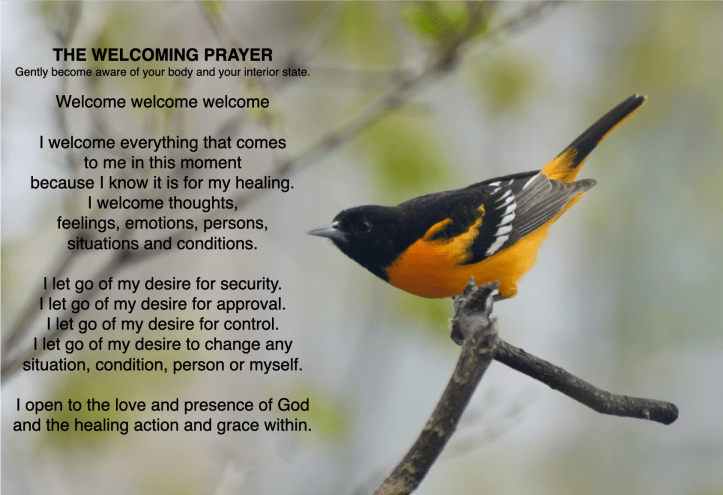
Photo by Lyle Penner Joe described the Welcoming Prayer as a powerful companion to Centering Prayer. It was developed by Mary Mrozowski, a spiritual teacher in NY who (along with Thomas Keating), wrote it in the ‘80s. She knew that people on a spiritual journey need prayer practices to help them “let go”. We all have a “false self” and the prayer helps dismantle it and heal the wounds of a lifetime by addressing where they are stored — in our bodies.
As Joe taught, Rumi’s beloved poem “The Guest House” came to mind. Rumi describes how our feelings (“A joy, a depression, a meanness”) come as unexpected visitors. “Even if they are a crowd of sorrows”, he suggests that each has “been sent as a guide from beyond” and we can “welcome and entertain them all”. In the same way, the Welcoming Prayer brings negative or uncomfortable thoughts and emotions into the light. Rather than repressing them (something I’m good at), it names, welcomes and then releases them to God.
They say that if Centering Prayer is practiced for 20 minutes/day, the Welcoming Prayer is for the other 23 hours and 40 minutes. It’s a “letting go” in the present moment, in the midst of ordinary life when we feel distracted or overwhelmed. It serves as an “on-the-fly” way to release our frustrations so they don’t take root, with the goal of returning to our true selves and the presence of God.
I’m well acquainted with how frustration can set in like a stubborn weed when I react to things that push my buttons. A flickering irritation can become full-blown, defenses and commentaries begin, and the waters of my inner well are stirred up. Oh what fun. We were taught that these frustrations originate in our unconscious well before we’re even aware of them from all the emotional programs for happiness that are hardwired into our particular personalities – the false self in action.
As an Enneagram two, esteem and affection show up as hungry ghosts who feed on all kinds of “people” dynamics. Some days, all it takes is a non-response to an email or text for the ruminating to begin. Other people may be hardwired for power/control or security/survival. These become our hidden agendas, which become worse when they collide with someone else’s.
So the Welcoming Prayer works in active life the same way as Centering Prayer, catching and releasing it all. There’s a slim window of opportunity before ‘thoughts’ and frustrations proceed into deeply afflictive emotions. Here, in the identified moment, the cycle can be broken.
Like Centering Prayer, we were taught that the Welcoming Prayer has three steps:
- Focus and sink in
- Welcome
- Let it go
- Focus — We were taught that the first and second steps are the most important ones. In this step, you allow yourself to feel what you are experiencing this moment as a sensation in your body. The idea here is not to repress what’s going on but to be aware and capture whatever emotion is happening. Sudden pressure in your head, stomach ache or furrowed brow? Maybe your ears start to plug up, as mine do during conflict? Don’t try to change, justify or analyze it. Just be present and focus on what you’re sensing and feeling. For myself, this is often the most difficult part. It’s way easier to stew or ignore it, or scurry to try to fix it, than it is to bring the discomfort to light. I’m learning to see how stopping, focusing and becoming aware of what’s going on is half the battle. “Oh! I’m anxious.”
- Welcome — This is the part that’s really counter-intuitive. We “welcome” whatever we’re experiencing this moment in the body as an opportunity to consent to the Divine indwelling. “Welcome, anger; welcome, pain; welcome, anxiety…”. It’s a paradoxical embrace of the shadow. By welcoming it, you create an atmosphere of inner hospitality, like Rumi’s guesthouse. You embrace it, disarm it, and remove its power. It’s not even about reciting the whole prayer. A simple “welcome” will do. *A crucial clarification to this step — It’s important to note that we’re just welcoming the psychological feeling/experience in the moment, not the thing itself. For instance, if someone has been diagnosed with colon cancer, they’re not welcoming the cancer, just the accompanying feelings, such as fear.
- Let it go — “All” that’s required here is to just wave farewell as the emotion recedes. Needless to say, it’s not easy! That good-bye needs to happen more than once given how unaware we usually are. Joe’s teaching here was helpful, “Remember, when you do let go, it’s just for now. But next time, you can do it again.” And remember that the real work of the Welcoming Prayer happens more in steps 1 & 2.
It’s simple but not easy! It’s important to remember we’re not trying to talk ourselves out of our emotions. It’s more about surrendering and letting go. All great spirituality, in fact, is about surrender.
To me, one of the most powerful lines in the welcoming prayer is why I welcome “everything that comes to me in this moment”. We do it “because I know it is for my healing.” It’s a powerful line. The assumption is that God is loving and desires nothing more than my healing and wholeness. Got a messy load of icky feelings? God can work with it, but first we need to welcome it all, just as God does. It’s like clearing a strip in the jungle for the planes to land.

One surprising (and perhaps minor) way it’s been helpful to me is in Winnipeg’s heat wave. I am NOT a fan of heat. If my inner temperature rises, especially at night, I feel trapped, uncomfortable and grumpy! It feels like getting stuck in the worst traffic jam (a thought that doesn’t exactly cool me down). One day it occurred to me that this too was something to welcome. The Serenity Prayer says to accept the things we cannot change so I’ve been learning to take a deep breath, notice how my body is feeling, and just say, “Welcome, discomfort.” I’ve noticed how I become calmer and can fall asleep again. Good-bye traffic jam.
Thomas Merton once observed that many of us are in love with our own noise. In some twisted way, we prefer the comfort of our own unkempt jungles but when we’re tired of living that way, it’s a relief to pivot to a better path, opening to “the love and presence of God and the healing action and grace within.”
It doesn’t mean that we should never gather the courage to “change the things we can”, as the Serenity Prayer also says. But, as with all the trials of our lives that we can’t change, God can use them to build character and develop that contentment in “every situation” that Paul writes about in Philippians 4:11.
The biggest difficulty with this practice? I’ve been surprised that for myself, it’s been simply remembering it’s even in my toolkit. Sometimes, I can ruminate for hours (or even days) before remembering Rumi’s words to welcome and entertain every guest. And then, I can start feeling impatient with myself as the should’s kick in. Shouldn’t I be further on this path?
“Welcome, impatience,” I say as I take a deep breath. “Welcome, beloved beginner,” the no-matter-what God says back.
“I am where I need to be. Everything around me includes and hides the sacred.”
— Mary Mrozowski

-
Catch & Release
Centering Prayer rests on the wager that if you can simply break the tyranny of your ordinary awareness, the rest will begin to unfold itself. –Cynthia Bourgeault
In April, Joe Stabile introduced us to Centering Prayer. I’d practiced it for a time some years ago, and his teaching inspired me to begin again (which was good because it’s our assignment for Cohort #2). As a social Enneagram 2, spending 20 minutes in silence does not come naturally. My morning “quiet time” is usually filled with reading a devotional book, journaling, and spoken prayers. Nothing wrong with all that, but it can lead to the false belief that I’m running the show. Centering prayer is different. It doesn’t require that I speak, think lofty thoughts, or even know what God is doing in my life.
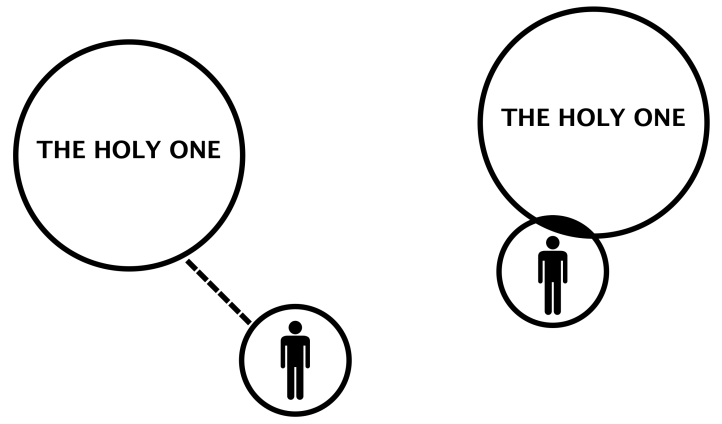
Joe shared this diagram. The picture on the left describes how many of us were raised (and I could relate). The “Holy One” may exist, but we think we have to work our way to connection. The diagram on the right illustrates Centering Prayer, how we are already intimately connected to the Divine. We just need to become aware of it.
What is Centering (aka Contemplative) Prayer? Joe defined it as a “word-less, trusting opening of the self to the Divine Presence”. In it, we are saying, “Here I am. I’m yours.” It is the simplest form of prayer there is, resting on what the Christian mystic St. John of the Cross wrote in the 16th century, “Silence is God’s first language.” As children, we were intimately connected to silence, but our connection to it typically recedes as we age. We spend so much time and energy on worrying and rushing about.
The directions for it are simple.
- Sit down for 20 minutes and silently open to the invisible yet always present Holy One
- Thoughts will come. Just let them go (with a chosen word or simply with a breath).
- Get up.
Thomas Keating (one of the main developers of this practice) described it as a prayer “not of attention, but of intention.” Everything begins and ends with simply doing it, and by setting our intention. The intention, we were told, is six words: “TO BE TOTALLY OPEN TO GOD.” When the intention gets fuzzy, the 20 minutes becomes more like daydreaming. Remembering those six words has been helpful and reorients me often.
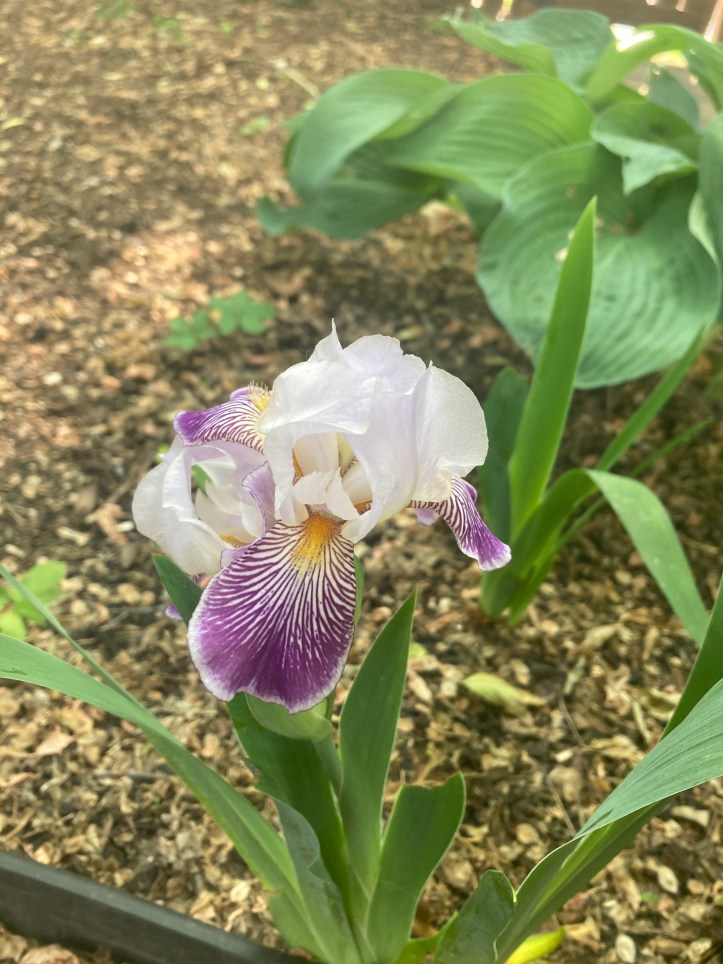
It was also helpful to learn about two kinds of silence. “Free silence” happens to us when we gaze at a flower or a sunset. “Intentional” silence is different. It’s a deliberate effort to restrain the wandering mind. It doesn’t come naturally. It is a discipline. And it almost always feels like work.
“It almost always feels like work.” Once I got back to Winnipeg, I was grateful Joe had given us this advance notice because that’s almost 100% what it usually feels like to me, at least so far. That old monkey mind is real, and it starts up quickly! Our thoughts, said Joe, are filled with interior dialogue, ideas, memories, commentary, emotions, physical stimulations like an itchy nose… I “let them go” and invariably a new one jumps in before I’ve even taken a breath. The goal is not to stop our thoughts but to detach from them by returning to the breath/word ever so gently.
So much more has been written about this ancient practice (Joe taught about it for several hours), and this blog post is to share a wee bit of the teaching and provide a brief “how it’s going” report. The only way to fail at it, we were taught, was to not do it, so I guess that means I’m doing ok! I have felt relief in letting go of the reins. Sometimes the 20 minutes feels like 60 and sometimes it feels like five minutes. No matter what, there’s comfort knowing that God will do something with the time I’m giving in ways I don’t need to know about. It’s been restful just to know that!
As a kid, my dad took me fishing once at Falcon Lake. It felt fun to be doing something different like this, and I had my dad all to myself. Floating in our yellow dinghy boat, it became “catch and release” all day long with all the tiny fish we reeled in. We had nothing to show for our day except smiles.
Centering prayer is like this, Joe said. Thoughts will come. Whatever shows up is fine, but we simply “catch and release” over and over again. All for the goal of developing awarenes that we’re already intimately connected to God. Sounds like a treasure worth hoping for.
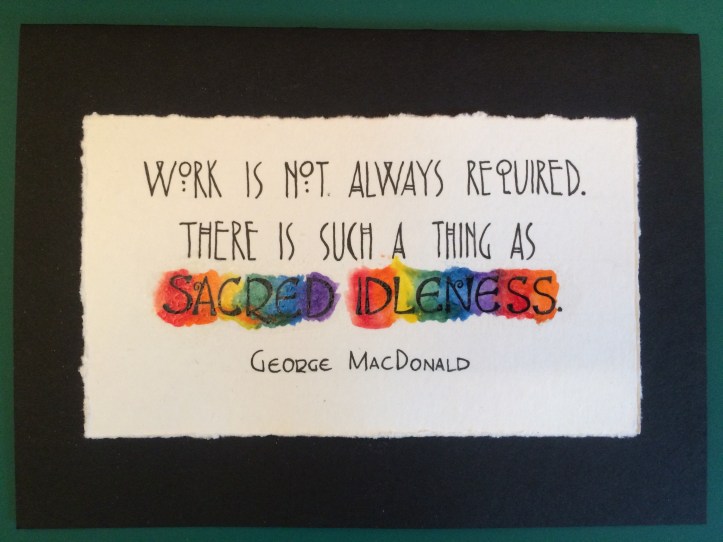
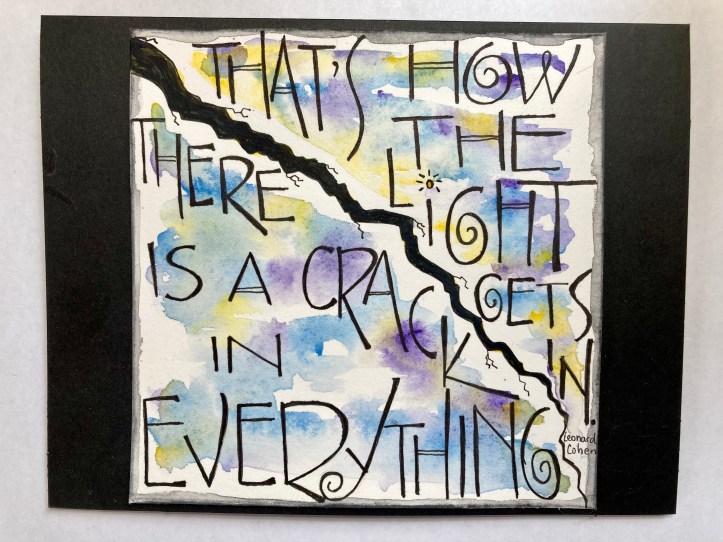
Calligraphy by Lydia -
Liminal Space
“There’s lots of liminal space in this room.”
That was how Joe Stabile summed up our sharing time on the first afternoon of cohort #2 this past April. Hunter Mobley had asked us each to talk about where we’ve all been at. Since January, we’d all read the same book and practiced the same two spiritual disciplines of keeping Sabbath and Fixed-Hour prayer. I was curious how it had all landed for others. How was everyone doing?
Over the next hour and a half, there were stories on the spectrum from desolation to consolation. People were vulnerable and open about the ebbs and flows of their lives. One cohort member admitted that he felt “armored”, and I saw myself in his brave confession.
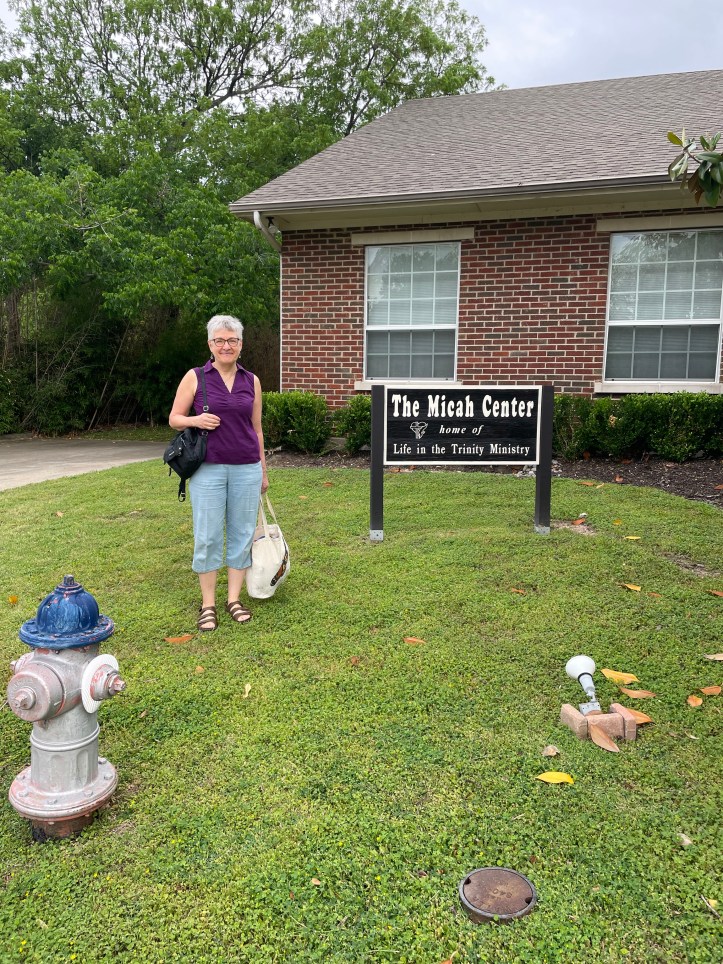
Arrival! Richard Rohr teaches that liminal space is the ultimate teachable space — in some sense, it’s the only teachable space. “It is when we are betwixt and between, have left one room but not yet entered the next room.”
“Betwixt and between” aptly described where I was at. The challenges of 2022 had indeed been like leaving a room, and I was still in transition in the hallway, feeling vulnerable. It was what had led me to join the cohort, and I’m sure I wasn’t the only one.
Liminal space is always holy space, says Rohr, but it is not an easy place. Staying there without answers feels like Job sitting on his dung heap, picking at his sores. God teaches us how to go there, trust the emptiness and stay till we’re led back out, like Jesus in the desert. It has the power to transform us when we are attentive to the presence of God.
I am grateful for our wise teachers Joe and Hunter who are helping us become attentive to God in the hallway. Over the three days, Joe taught us about Centering Prayer and the Welcoming Prayer, and Hunter taught new Enneagram insights that dovetailed well with Joe’s teaching. It was deeply relaxing to soak in wisdom.
On Saturday, we ended our time together in the beautiful chapel at the Micah Center, where Joe led us in a celebration of Eucharist (communion). The word Eucharist means “thanksgiving”, and we were first invited to offer words or phrases of what we were grateful for and the energy in the room felt sacred. My words summed up the gratitude I was feeling: “Hope for transformation rekindled”. Perhaps no one understood or even heard my mumbled prayer, but I knew that God knew.
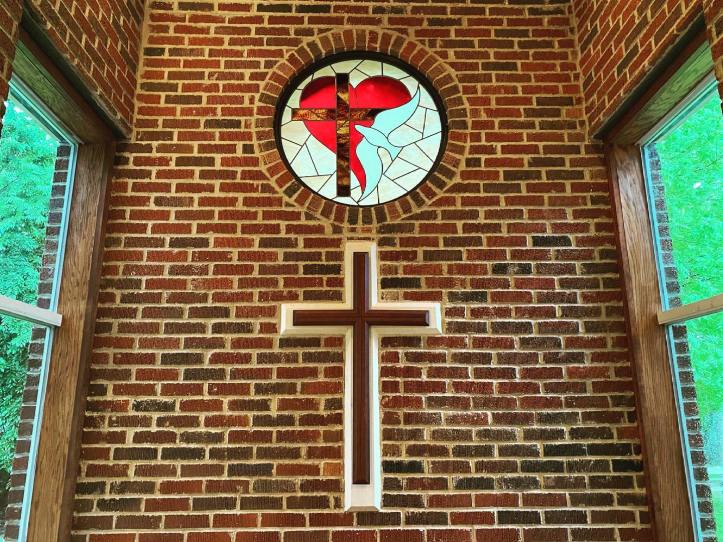
The lovely chapel at the Micah Center It’s difficult to put in writing how sacred this time seemed to me, certainly one of the most meaningful communion celebrations in my life. When you’re in a liminal place, receiving sustenance changes everything. It was like some of the unresolved, open wounds in me got stitched up as we shared the bread and wine that seemed like medicine. Later, I asked my cohort friend how his armor was doing, and his grin assured me it was no longer an issue. I felt the same. All of us all said good-byes until August, and just like that cohort #2 was over.
The effects of our time stayed with me for days. Sitting down for my daily centering prayer, I felt a big inner yes. To be honest though, coming home was not as easy (though I guess I shouldn’t have been surprised). My anxieties got amped up again and Centering Prayer became crowded with monkey mind, all tempting me to think the rekindled hope I’d felt was not real. Good thing we’d been taught that the only way to fail at Centering Prayer was not to do it, so I continue to stay here in what Father Greg Boyle calls the “no-matter-what-ness of God”.
Sharing all this with my friend Bev one day, she suggested maybe I’m still in the hallway. Still betwixt and between. I knew she was right and admitting it was helpful. Perhaps what I’d glimpsed in the chapel was more like peeking into the next room from the hallway. Already/not yet, as the theologians put it. As if underscoring this insight, the next day my other friend named Bev emailed me in her own season of trial, “I assume that we are always walking through miracles in the midst of hardships,” she wrote. “Sometimes God draws the curtain a bit and we can see backstage. Most times it has to be faith alone.”
I have desired so deeply to be transformed this year but perhaps my idea of “transformation” is itself being transformed. Did I imagine 2022 would be replaced by a blaze of glory? Maybe I’ll simply begin to see myself as unshakably beloved, even in the hallway; even betwixt and between. All I have to do is pay attention to the activity of God who knows no boundaries. As Joe said, it’s simple but not easy. God grant me faith.
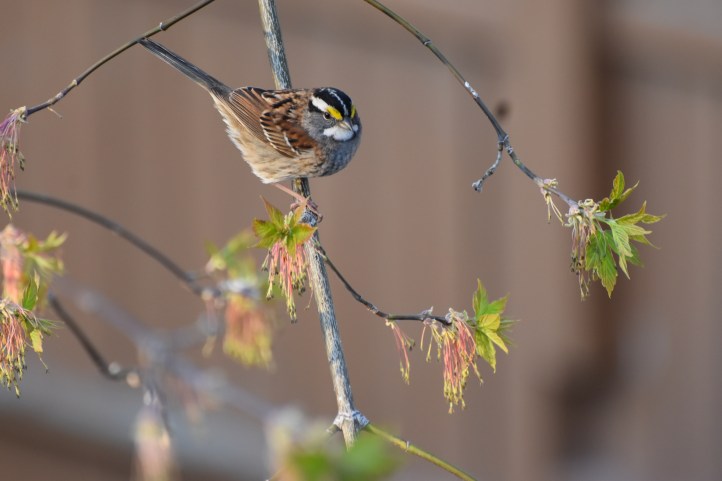
In the meantime, spring is finally arriving in Winnipeg, and the migrating birds are belting out their songs in their own liminal space.
-
Subscribe
Subscribed
Already have a WordPress.com account? Log in now.
 The Contemplative Blogger