Just before we ended cohort #2 in April, Joe introduced us to our second spiritual practice — the “Welcoming Prayer”. “Oh good,” I immediately thought, “I know this one!” I’d been introduced to it on Suzanne’s recording on the Enneagram and Grieving the previous summer. I’d memorized it, recited it often and even made fridge magnets for everyone in my house church. I thought I knew all there was to know but April’s teaching deepened it.
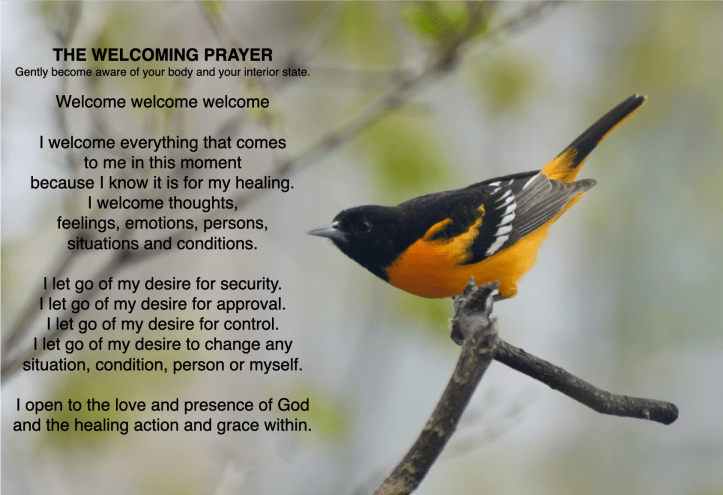
Joe described the Welcoming Prayer as a powerful companion to Centering Prayer. It was developed by Mary Mrozowski, a spiritual teacher in NY who (along with Thomas Keating), wrote it in the ‘80s. She knew that people on a spiritual journey need prayer practices to help them “let go”. We all have a “false self” and the prayer helps dismantle it and heal the wounds of a lifetime by addressing where they are stored — in our bodies.
As Joe taught, Rumi’s beloved poem “The Guest House” came to mind. Rumi describes how our feelings (“A joy, a depression, a meanness”) come as unexpected visitors. “Even if they are a crowd of sorrows”, he suggests that each has “been sent as a guide from beyond” and we can “welcome and entertain them all”. In the same way, the Welcoming Prayer brings negative or uncomfortable thoughts and emotions into the light. Rather than repressing them (something I’m good at), it names, welcomes and then releases them to God.
They say that if Centering Prayer is practiced for 20 minutes/day, the Welcoming Prayer is for the other 23 hours and 40 minutes. It’s a “letting go” in the present moment, in the midst of ordinary life when we feel distracted or overwhelmed. It serves as an “on-the-fly” way to release our frustrations so they don’t take root, with the goal of returning to our true selves and the presence of God.
I’m well acquainted with how frustration can set in like a stubborn weed when I react to things that push my buttons. A flickering irritation can become full-blown, defenses and commentaries begin, and the waters of my inner well are stirred up. Oh what fun. We were taught that these frustrations originate in our unconscious well before we’re even aware of them from all the emotional programs for happiness that are hardwired into our particular personalities – the false self in action.
As an Enneagram two, esteem and affection show up as hungry ghosts who feed on all kinds of “people” dynamics. Some days, all it takes is a non-response to an email or text for the ruminating to begin. Other people may be hardwired for power/control or security/survival. These become our hidden agendas, which become worse when they collide with someone else’s.
So the Welcoming Prayer works in active life the same way as Centering Prayer, catching and releasing it all. There’s a slim window of opportunity before ‘thoughts’ and frustrations proceed into deeply afflictive emotions. Here, in the identified moment, the cycle can be broken.
Like Centering Prayer, we were taught that the Welcoming Prayer has three steps:
- Focus and sink in
- Welcome
- Let it go
- Focus — We were taught that the first and second steps are the most important ones. In this step, you allow yourself to feel what you are experiencing this moment as a sensation in your body. The idea here is not to repress what’s going on but to be aware and capture whatever emotion is happening. Sudden pressure in your head, stomach ache or furrowed brow? Maybe your ears start to plug up, as mine do during conflict? Don’t try to change, justify or analyze it. Just be present and focus on what you’re sensing and feeling. For myself, this is often the most difficult part. It’s way easier to stew or ignore it, or scurry to try to fix it, than it is to bring the discomfort to light. I’m learning to see how stopping, focusing and becoming aware of what’s going on is half the battle. “Oh! I’m anxious.”
- Welcome — This is the part that’s really counter-intuitive. We “welcome” whatever we’re experiencing this moment in the body as an opportunity to consent to the Divine indwelling. “Welcome, anger; welcome, pain; welcome, anxiety…”. It’s a paradoxical embrace of the shadow. By welcoming it, you create an atmosphere of inner hospitality, like Rumi’s guesthouse. You embrace it, disarm it, and remove its power. It’s not even about reciting the whole prayer. A simple “welcome” will do. *A crucial clarification to this step — It’s important to note that we’re just welcoming the psychological feeling/experience in the moment, not the thing itself. For instance, if someone has been diagnosed with colon cancer, they’re not welcoming the cancer, just the accompanying feelings, such as fear.
- Let it go — “All” that’s required here is to just wave farewell as the emotion recedes. Needless to say, it’s not easy! That good-bye needs to happen more than once given how unaware we usually are. Joe’s teaching here was helpful, “Remember, when you do let go, it’s just for now. But next time, you can do it again.” And remember that the real work of the Welcoming Prayer happens more in steps 1 & 2.
It’s simple but not easy! It’s important to remember we’re not trying to talk ourselves out of our emotions. It’s more about surrendering and letting go. All great spirituality, in fact, is about surrender.
To me, one of the most powerful lines in the welcoming prayer is why I welcome “everything that comes to me in this moment”. We do it “because I know it is for my healing.” It’s a powerful line. The assumption is that God is loving and desires nothing more than my healing and wholeness. Got a messy load of icky feelings? God can work with it, but first we need to welcome it all, just as God does. It’s like clearing a strip in the jungle for the planes to land.
One surprising (and perhaps minor) way it’s been helpful to me is in Winnipeg’s heat wave. I am NOT a fan of heat. If my inner temperature rises, especially at night, I feel trapped, uncomfortable and grumpy! It feels like getting stuck in the worst traffic jam (a thought that doesn’t exactly cool me down). One day it occurred to me that this too was something to welcome. The Serenity Prayer says to accept the things we cannot change so I’ve been learning to take a deep breath, notice how my body is feeling, and just say, “Welcome, discomfort.” I’ve noticed how I become calmer and can fall asleep again. Good-bye traffic jam.
Thomas Merton once observed that many of us are in love with our own noise. In some twisted way, we prefer the comfort of our own unkempt jungles but when we’re tired of living that way, it’s a relief to pivot to a better path, opening to “the love and presence of God and the healing action and grace within.”
It doesn’t mean that we should never gather the courage to “change the things we can”, as the Serenity Prayer also says. But, as with all the trials of our lives that we can’t change, God can use them to build character and develop that contentment in “every situation” that Paul writes about in Philippians 4:11.
The biggest difficulty with this practice? I’ve been surprised that for myself, it’s been simply remembering it’s even in my toolkit. Sometimes, I can ruminate for hours (or even days) before remembering Rumi’s words to welcome and entertain every guest. And then, I can start feeling impatient with myself as the should’s kick in. Shouldn’t I be further on this path?
“Welcome, impatience,” I say as I take a deep breath. “Welcome, beloved beginner,” the no-matter-what God says back.
“I am where I need to be. Everything around me includes and hides the sacred.”
— Mary Mrozowski
 The Contemplative Blogger
Lydia, your writing is a great paraphrase and accurate reminder of what we learned. I do not use the Welcoming Prayer very often and it is because I forget it’s right here for me!
Thank you for your encouragement and connection through your excellently written blog. Blessings in Abundance my Canadian friend! The next time I feel the midsummer heat, I will think of you and ‘welcome discomfort’ and give thanks for the reminder!
Your FOUR friend, Lori
LikeLiked by 1 person
Thanks Lyds for walking me through the deep and intricate labyrinth of Prayerful Welcome. There’s a simplicity here and yet many soulful layers that point beyond technique or platitude. I admit to a resistance in myself, a fear that it will just become trite and emotionally dishonest. Something that is easy for me to fall into. My hunch is that even assenting to the first step is a process that takes time. Again, thanks for the clarity you bring to this.
LikeLiked by 2 people
Oh my I resonate with these words I’m well acquainted with how frustration can set in like a stubborn weed when I react to things that push my buttons. A flickering irritation can become full-blown, defenses and commentaries begin, and the waters of my inner well are stirred up. Oh what fun. We were taught that these frustrations originate in our unconscious well before we’re even aware of them from all the emotional programs for happiness that are hardwired into our particular personalities – the false self in action. Here I sit taking a deep breath understanding that I am a beautiful spirit living a human experience. It’s ok to feel what I feel. In recognizing I can make a choice and choose better.
LikeLike
Thanks Mireya! I’m with you in taking a deep deep breath to learn all that! Taking that deep breath is already a choice towards seeing ourselves as God sees us. It’s a lifelong journey with God’s abundant mercies helping us every moment, even when we aren’t always aware of them. 🦋 Welcome to the blog.
LikeLiked by 1 person
Hi, good to read about the Welcoming Prayer and more. Thank you for your blog. Greetings from a contemplative friend.
LikeLike