In the center of this silence is a thought I’d like to keep
When I step out in the crowd, when I’m swimming in the deep.
This thought is not of “peace” nor is it bluebells breezing free.
It’s standing in the center storm and knowing I am me.
– by Lydia age 28
Despite being an extrovert, all my life I’ve been drawn to silence. I’ve had a desire to know who “me” is, even in the center storm. No doubt this desire came out of a radical feeling of being lost to myself – the flip side of the silence. When I left teaching in 2014 and discovered Julian of Norwich, I learned the word “contemplative”. My meditation room became a “cell” a bit like she had (though not so extreme). It’s no surprise that a Contemplative Cohort would be a draw.
But…what exactly does it mean to be a “Contemplative” or a “mystic”? Are my feet going to start lifting off the ground from sheer holiness when I return from Dallas? Cue the angel choirs! As I’ve shared news of my Dallas pilgrimage, the last thing I want is to make it sound like I’m going to get all spiritual or holier-than-thou. This creates a them/me dichotomy that isn’t true. More than anything, I just want to become more human; more who I was created to be.
Joe Stabile says that contemplative practices are “anything that draws you closer to God”. I like that. It can be formal like Centering Prayer or prep for Bible study, or it can be informal like walking, swimming, making bread, tending bees, puzzling, arranging flowers… Defined that way, everything can be a contemplative practice, even breathing. Like yeast in bread, the fruits of the Spirit such as peace and love expand our hearts, and we become more human.

As a kid, I loved riding my banana bike along the hill near our place. It was a space all on my own, and my imagination felt free and content there. I imagined I was pulling a train of (very low-maintenance) children behind me. My spirit felt unbounded and the child who felt invisible at home suddenly felt wanted and seen. Years later as an adult, reading Greg Boyd’s book on spiritual practices, I was invited me to imagine a place from childhood as somewhere to “be with Jesus”, and a spot on this hill is one I’ve often returned to in prayer.
The subtitle of Rohr’s book is “Learning to See As the Mystics See”. This challenge might sound heady and not for ordinary folk, but Rohr says, “Don’t let the word ‘mystic’ scare you off.” A mystic is simply someone who has moved from mere belief systems to actual inner experience of God, like I had as a kid on my bike.

A contemplative or mystic sees with the third-eye. To explain, he describes three ways to view a sunset. The first is what most of us do, use our senses to just enjoy the event in itself — the immense physical beauty. It’s a good way. The next way is through the second eye as we make sense of the universe. We might wonder how the planets cycle to make the sun visible. This way of seeing is even better.
The third way of seeing a sunset is first to enjoy the first and second ways, but then to also contemplate the mystery of it all. Watching the sunset, we are before “an underlying mystery, coherence, and spaciousness”that connects us with everything else. This is the best way. Third-eye seeing is the way the mystics see. We become open and nonresistant to God who was there all along (even behind the couch!). We become anything but “holier-than-thou” as it makes us humble, compassionate, and knowing that we don’t know.
I usually forget about my third-eye. Most of us do. Lacking the contemplative gaze, we end up seeing holy things faintly, trying to understand great things with a whittled-down mind, and trying to love God with our own small and divided heart. I love Rohr’s example, “It’s like trying to view the galaxies with a $5 pair of binoculars”.
Rohr defines contemplation as larger seeing; “full-access knowing”.And prayer is an umbrella word for any interior journeys or practices that allow you to experience faith, hope and love within yourself. It’s not technique for getting things, or a pious exercise that somehow makes God happy.
As the cohort comes closer, I’ve reflected on my own contemplative practices, both formal and informal. For decades, I’ve done an early morning “quiet time”, reading a devotional, praying and sometimes journaling. Most often, I’m staring out the window at the birds, aware of how difficult it is to feel even a remote connection to God. Thoughts, feelings, persons, situations and conditions all seem to be the main drama.
I’m slowly learning to let go of worries of “not connecting”. Like the sun, God is there whether I’m aware or not. Be not anxious, says Jesus. Merton said we’re more like an apple ripening on a tree in its good time.
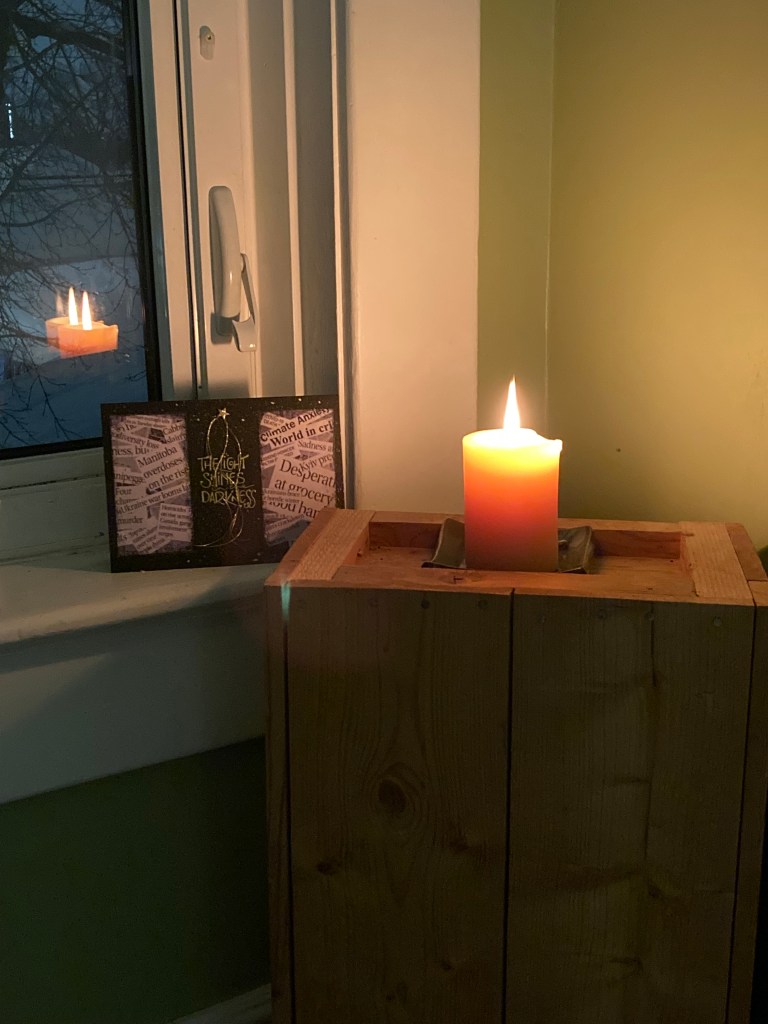
Lately during the dark mornings of Advent, simply gazing at a candle has been a gift in opening that third-eye and drawing me back to Mystery. Rohr says in prayer, we merely keep returning the divine gaze and we become its reflection, almost in spite of ourselves. “Everything exposed to the light itself becomes light,” says Ephesians 5:14, so God is doing the work. It’s a relationship, not an idea. We are all standing under the same waterfall of God’s mercy, warts and all, and when we’re ready, we’ll become aware of it.
Here’s to us all becoming mystics, simply drawing closer to God even in the center storm. Like that kid riding her banana bike so long ago, maybe it’s easier than we think.
 The Contemplative Blogger